
Table of contents
Obstructive sleep apnoea is a condition in which the throat repeatedly collapses during sleep. Breathing then stops or becomes very shallow. Each episode lasts more than 10 seconds and usually ends with a brief awakening that most people with the condition do not remember (1). The main risk factor is excess body weight: about 70-80% of people with sleep apnoea are overweight or have obesity. This is why Polish guidelines regard weight loss as the primary treatment for sleep apnoea in people with obesity (2).
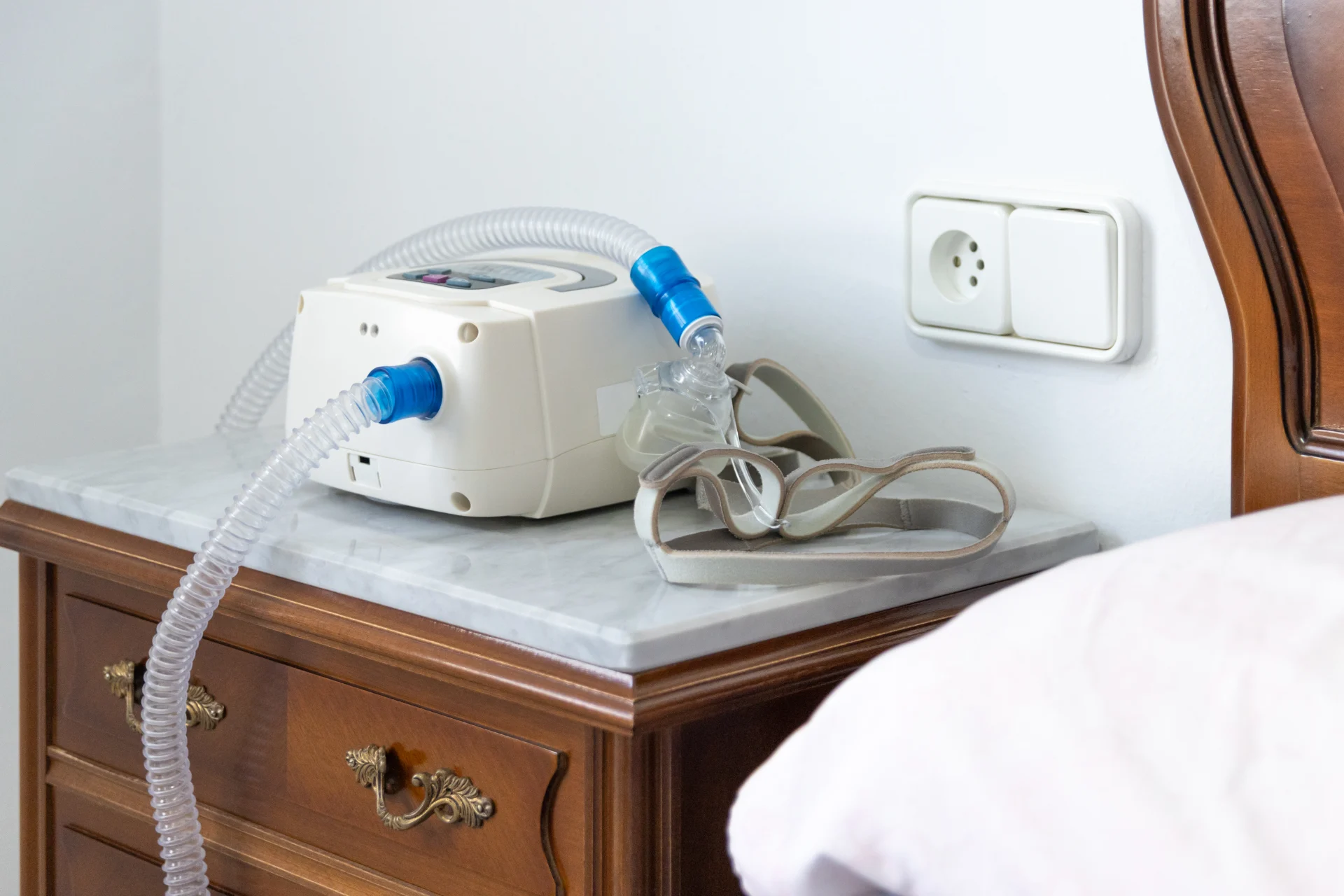
Tirzepatide (sold in Poland as Mounjaro) is the first medicine approved in the United States to treat sleep apnoea (3). In the two SURMOUNT-OSA trials in adults with obesity and moderate to severe sleep apnoea, the number of apnoeas (pauses in breathing) and hypopnoeas (episodes of shallow breathing) during sleep fell by half or slightly more after a year, while in the placebo groups it barely changed (4). In the European Union, tirzepatide does not have a separate indication for sleep apnoea, but sleep apnoea is one of the conditions for which it can be prescribed from a BMI of 27 (5, 6). US sleep medicine specialists recommend that the medicine should not replace a CPAP machine, which delivers air under positive pressure during sleep and keeps the airway from narrowing (5, 7). Whether the machine is still needed is decided by a doctor after a repeat sleep study.
In brief
- In an observational study of 690 adults, a 10% fall in body weight was linked to an average reduction of about a quarter in the number of apnoeas and hypopnoeas during sleep. The effect varies from person to person, however, and only a sleep study can show whether sleep apnoea has gone.
- In the SURMOUNT-OSA trials, after a year, people taking tirzepatide had on average 25-29 fewer apnoeas and hypopnoeas per hour of sleep, and people on placebo about 5 fewer. People taking the medicine lost on average 18-20% of their body weight. In 42-50% of them, sleep apnoea decreased to a level at which CPAP may not be recommended.
- In the US, tirzepatide has been approved under the name Zepbound since 20 December 2024 to treat moderate to severe sleep apnoea in adults with obesity. In the European Union, there is no separate indication: the European Medicines Agency considered it unnecessary because these patients are already covered by the indication for obesity treatment, and it added the trial results to the summary of product characteristics (SmPC) for Mounjaro (as of November 2026).
- Do not stop using CPAP on your own after starting obesity treatment. The medicine can be taken with or without CPAP, and the doctor assesses whether you still need the machine based on a repeat sleep study.
What did the SURMOUNT-OSA trials of tirzepatide show?
In the two one-year SURMOUNT-OSA trials, tirzepatide reduced the number of breathing events during sleep by an average of half or slightly more, while in the placebo groups this number fell by 2-3%. The trials included adults with obesity and moderate to severe sleep apnoea who did not have diabetes (4).
A total of 469 people took part. In the first trial (234 people), participants could not or did not want to use a positive airway pressure device such as CPAP. In the second trial (235 people), participants had been using such a device for at least 3 months and continued to use it. In each trial, half of the participants took tirzepatide once a week at the maximum tolerated dose (10 or 15 mg), and the other half took placebo. Everyone received advice on a diet with a deficit of 500 kcal a day and on doing at least 150 minutes of physical activity a week. The severity of sleep apnoea was measured with the apnoea-hypopnoea index (AHI), the number of apnoeas and hypopnoeas per hour of sleep: a score of 15 to 30 means moderate sleep apnoea, and above 30 severe (1). At the start, the average AHI was about 50 and the average BMI about 39. Sleep apnoea was assessed by polysomnography in a sleep laboratory (4).
| Result after 52 weeks | Trial in people not using CPAP: tirzepatide / placebo | Trial in people using CPAP: tirzepatide / placebo |
|---|---|---|
| Average reduction in apnoeas and hypopnoeas per hour of sleep (AHI) | 25.3 / 5.3 | 29.3 / 5.5 |
| Average percentage reduction in AHI | 50.7% / 3.0% | 58.7% / 2.5% |
| People whose AHI fell by at least half | 61.2% / 19.0% | 72.4% / 23.3% |
| People with an AHI below 5, or from 5 to 14 without excessive sleepiness (Epworth score up to 10 points) | 42.2% / 15.9% | 50.2% / 14.3% |
| Average weight loss | 17.7% / 1.6% | 19.6% / 2.3% |
| Average fall in systolic blood pressure after 48 weeks | 9.5 / 1.8 mmHg | 7.6 / 3.9 mmHg |
Participants in the trial of CPAP users stopped using the machine for 7 days before each sleep study, so the measurement showed the severity of sleep apnoea without it (4).
For people who sleep with CPAP, the most important result is an AHI below 5, or from 5 to 14 without excessive sleepiness. According to the authors of the trials, at this level of sleep apnoea, CPAP treatment may not be recommended. After a year, this was the result in 42% of people treated with tirzepatide in the trial of people not using CPAP and in 50% in the trial of CPAP users. The other participants treated with tirzepatide did not reach this level (4).
People taking tirzepatide also reported fewer problems with sleep and with daytime functioning than people on placebo (4). The authors of a further analysis of these trials believe that the benefits for the heart and metabolism are probably greatest when both conditions, sleep apnoea and obesity, are treated (8).
Why do different sources give different SURMOUNT-OSA results?
The results in the table were calculated for all participants, including those who stopped taking the medicine. The authors also reported a second analysis, which estimates the effect if the medicine was taken as planned for the whole year. In this analysis, the AHI fell by an average of 27.4 and 30.4 events per hour respectively, and in the placebo groups by 4.8 and 6.0 (4). These are the figures given in the Mounjaro SmPC, together with a fall in AHI of 55.0% and 62.8% and in body weight of 18.1% and 20.1% (6).
Side effects of tirzepatide in the sleep apnoea trials
The most common side effects affected the digestive system. They were usually mild or moderate and appeared mainly while the dose was being increased (4).
| Symptom (range across both SURMOUNT-OSA trials) | Tirzepatide | Placebo |
|---|---|---|
| Diarrhoea | 21.8-26.3% | 8.8-12.5% |
| Nausea | 21.8-25.4% | 5.3-10.0% |
| Vomiting | 9.2-17.5% | 0.9-4.2% |
| Constipation | 15.1-15.8% | 2.5-4.4% |
In the two trials, 4.4% and 3.4% of participants stopped taking tirzepatide because of side effects, compared with 1.7% and 7.0% who stopped placebo. In the trial of CPAP users, acute pancreatitis was confirmed in 2 people taking tirzepatide (4). Our article on side effects of obesity medication describes ways to ease nausea, diarrhoea and constipation.
What did the SURMOUNT-OSA trials not show?
The trials lasted a year, so they do not show how tirzepatide affects sleep apnoea over longer treatment or whether it reduces the risk of heart attack, stroke and death in people with sleep apnoea. They did not include people with diabetes or people without obesity (4). Nor do they answer whether adding tirzepatide to CPAP gives an additional benefit, because sleep apnoea was measured after a 7-day break from the machine (4, 6). The trials were funded by the manufacturer of the medicine, Eli Lilly, and the statistical analyses were carried out by its employees (4).
Is tirzepatide approved for treating sleep apnoea?
In the United States, yes; in the European Union, not as a separate indication (as of November 2026). In Poland, a doctor can prescribe tirzepatide to a person with sleep apnoea as part of obesity treatment if the patient meets the criteria for that indication (5, 6).
On 20 December 2024, the US Food and Drug Administration (FDA) approved tirzepatide under the name Zepbound to treat moderate to severe obstructive sleep apnoea in adults with obesity. The medicine is used together with a reduced-calorie diet and increased physical activity (3).
On 13 December 2024, the European Medicines Agency (EMA) completed its assessment of an application for the same indication for Mounjaro. Its expert committee concluded that Mounjaro reduces the severity of sleep apnoea in adults with obesity, but that a separate indication is not needed because these patients are already covered by the weight management indication. The results of the SURMOUNT-OSA trials were added to the SmPC (5).
Mounjaro is used together with a reduced-calorie diet and increased physical activity in adults with a BMI of at least 30, or with a BMI of 27 to less than 30 and at least one weight-related condition. Obstructive sleep apnoea is one of these conditions. The patient leaflet adds that in people with sleep apnoea and obesity, the medicine can be used with or without positive airway pressure therapy, such as CPAP (6).
What is known about semaglutide and liraglutide for sleep apnoea?
Semaglutide (Wegovy) and liraglutide 3 mg can also be prescribed to someone with a BMI of 27 to less than 30 who has sleep apnoea (2). However, the Wegovy SmPC does not describe a trial in people with sleep apnoea (9).
Liraglutide was tested in the SCALE Sleep Apnea trial. It included 359 adults with obesity and moderate to severe sleep apnoea who did not want to or could not use CPAP. For 32 weeks, they took liraglutide 3 mg or placebo. The AHI fell by an average of 12.2 in the liraglutide group and 6.1 in the placebo group, and body weight by 5.7% and 1.6% respectively. In an additional analysis, the more weight a participant lost, the more their sleep apnoea improved (10).
For obesity with sleep apnoea, Polish guidelines name three first-choice medicines: liraglutide, semaglutide and tirzepatide (2). The doctor chooses the medicine.
Can I stop using CPAP when I start taking obesity medication?
Not on your own. Tirzepatide (Mounjaro) can be used together with CPAP (6). The medicine may reduce sleep apnoea enough for the machine to no longer be needed, but it is impossible to predict before treatment who this will happen to, and many people will still need it. A repeat sleep study settles the question, and the decision is made by the doctor treating your sleep apnoea (7).
In a 2026 fact sheet for doctors, the American Academy of Sleep Medicine (AASM) recommends that tirzepatide be part of sleep apnoea treatment alongside CPAP, oral appliances or surgery, rather than a replacement for CPAP. It also notes that there are no studies directly comparing tirzepatide with other sleep apnoea treatments (7).
According to Polish recommendations developed by organisations including the Polish Respiratory Society (Polskie Towarzystwo Chorób Płuc), CPAP is used in all patients with severe sleep apnoea (an AHI above 30). In moderate sleep apnoea, the machine is recommended for people who have marked daytime sleepiness (more than 10 points on the Epworth Sleepiness Scale) and heart or blood vessel disease or an increased risk of it (1). In the SURMOUNT-OSA trials, 63-68% of participants had severe sleep apnoea at the start (6). If the AHI falls by half, for example from 50 to 25, sleep apnoea changes from severe to moderate, but it does not go away.
When should you repeat a sleep study after losing weight?
The AASM advises considering repeat respiratory polygraphy or polysomnography once your weight stops falling and stabilises. The need for CPAP is reassessed as the AHI and body weight fall (7). Until then, keep using the machine as before. Once you have lost a noticeable amount of weight, tell the doctor treating your sleep apnoea, because they decide on further CPAP use and on when the test should be done.
Additional rules apply to drivers. According to Polish recommendations for doctors who examine drivers, the effectiveness of treatment without CPAP, for example after significant weight loss, is confirmed by polysomnography showing an AHI below 10 (1).
To maintain the improvement, you need to keep your weight under control (7). After stopping obesity medication, body weight is likely to start rising again (7), and in the observational study of 690 adults, a 10% weight gain was linked to a 32% increase in AHI (11). We describe what happens after treatment ends in our article on stopping obesity medication.
Why does obesity make sleep apnoea more likely?
Excess body fat, especially in the abdomen and at the front of the neck, makes breathing harder during sleep. When a person with obesity lies on their back, the tissues around the throat press on it more, and the throat collapses more easily (2).
Other factors that make sleep apnoea more likely include a neck circumference of more than 43 cm in men, an abnormal structure of the upper airway, jaws and facial bones, an underactive thyroid (hypothyroidism), smoking, drinking alcohol and taking sleeping pills (1). This is why sleep apnoea also occurs in people with a healthy body weight.
How much weight do you need to lose for sleep apnoea to improve?
According to the Polish obesity treatment guidelines, the AHI may fall after a weight loss of at least 7-11%, but the effect can vary considerably from person to person (2). In a US observational study of 690 randomly selected working adults who were examined twice, 4 years apart, a 10% weight loss was linked to an average 26% reduction in AHI. A 10% weight gain was linked to a 32% increase in AHI and a sixfold higher risk of moderate to severe sleep apnoea (11).
Guidelines from the American Thoracic Society, a US society of lung specialists, recommend that every patient with sleep apnoea and overweight or obesity be treated with lifestyle changes: a reduced-calorie diet, more physical activity and support in changing habits. The guidelines consider obesity medication and bariatric surgery appropriate for selected people who need extra help losing weight (12). We describe the first steps in our article on where to start with obesity treatment.
How is sleep apnoea diagnosed?
Sleep apnoea is diagnosed with a sleep study: polysomnography or respiratory polygraphy. Questionnaires and a description of symptoms help decide whether a test is needed, but on their own they are not enough for a diagnosis (13).
The condition is diagnosed when there are at least 5 apnoeas or hypopnoeas, each lasting more than 10 seconds, per hour of sleep. An AHI of 5 to less than 15 means mild sleep apnoea, 15 to 30 moderate, and above 30 severe. In Polish epidemiological studies, obstructive sleep apnoea was found in 7.5% of the people examined (1).
Symptoms of sleep apnoea at night and during the day
Night-time symptoms of sleep apnoea include loud, irregular snoring interrupted by sudden silence, pauses in breathing noticed by a partner or family member, waking up feeling breathless or choking, and frequent urination at night. Daytime symptoms include sleepiness, morning tiredness and headaches, problems with memory and concentration, a dry mouth and reduced libido (1, 14). Sleep apnoea is also a common cause of high blood pressure that is difficult to control with medication (2).
If you have these symptoms, see your GP (family doctor) first. After talking to you, the GP decides on further tests (14).
The doctor may ask you to fill in the Epworth Sleepiness Scale. It has 8 questions about how easily you doze off in everyday situations. For each question, you choose an answer worth 0-3 points, so the total score ranges from 0 to 24 points. A score above 10 points means excessive daytime sleepiness, and above 15 points severe sleepiness. However, the scale is not used to diagnose sleep apnoea: in a review of 108 studies, it identified moderate sleep apnoea in only 47% of the people who had it (1).
How does polysomnography differ from respiratory polygraphy?
Polysomnography records both breathing and sleep, while respiratory polygraphy records breathing only. Polygraphy is usually done at home, and polysomnography most often in a sleep laboratory (1).
| Polysomnography | Respiratory polygraphy | |
|---|---|---|
| Where it is done | usually in a sleep laboratory, overnight under staff supervision; there is also an unsupervised version done on an outpatient basis | on an outpatient basis, usually at the patient's home |
| What it records | breathing, blood oxygen levels and sleep structure, that is, the sleep stages and awakenings | at least 4 parameters, including breathing movements of the chest and abdomen, airflow and blood oxygen levels, without assessing sleep |
| When it is chosen | as the standard test for diagnosing sleep apnoea; instead of polygraphy in people with significant heart or lung disease or weakness of the breathing muscles, after a stroke, in people who regularly take opioid painkillers and in people with severe insomnia | in adults without serious coexisting conditions whose symptoms suggest moderate to severe sleep apnoea |
If polygraphy did not show sleep apnoea or gave an unclear result, and the doctor still suspects it, the next step is polysomnography (13). The Polish obesity treatment guidelines recommend polysomnography for everyone with suspected sleep apnoea, which is why this test is on the list of tests before obesity treatment (2).
Sleepiness at the wheel and other sleep apnoea symptoms that need prompt medical attention
If you fall asleep or struggle to stay awake while driving, do not drive and see a doctor as soon as possible. Drivers with sleep apnoea cause accidents more often: a review of studies estimated that their risk of a crash is 1.21 to 4.89 times higher than that of drivers without sleep apnoea (15). In the Polish algorithm for doctors who examine drivers, excessive daytime sleepiness is a contraindication to driving until it resolves (1).
Also see a doctor promptly if you fall asleep during the day in situations that require concentration, such as during a conversation or a meal. This kind of sleepiness is typical of severe sleep apnoea (1). You also need to see a doctor if someone close to you notices that you stop breathing at night, if you wake up feeling as if you are choking, or if your blood pressure stays high despite treatment (1, 2).
Sleep apnoea and your driving licence
Before the medical examination for a driving licence, a driver or prospective driver fills in a health declaration. Two questions concern sleep: whether you have ever been examined for a sleep disorder or been told by a doctor that you have sleep apnoea, and whether anyone has noticed that you stop breathing during sleep. If the doctor suspects moderate to severe sleep apnoea, they refer you for a specialist test and, until the condition is confirmed or ruled out, may find you unfit to drive (16).
You can drive with diagnosed moderate to severe sleep apnoea if you meet three conditions. You need to present a medical report from the doctor treating your sleep apnoea confirming that treatment has started, follow the recommendations for preventing sleepiness and have regular follow-up examinations. These take place every 3 years for categories AM, A1, A2, A, B1, B, B+E and T, and every year for categories C and D and in other cases listed in the regulation, for example for drivers of emergency vehicles (16). The Polish recommendations for doctors who examine drivers specify that CPAP treatment is considered to be used properly when the machine is used for at least 4 hours a night on at least 70% of nights, for at least a month from the start of treatment. Treatment is confirmed as effective if polygraphy performed with CPAP shows an AHI below 10 and excessive sleepiness has resolved (1).
What else besides medication reduces the severity of sleep apnoea?
Apart from weight loss, Polish recommendations advise everyone with sleep apnoea to avoid alcohol, sleeping pills and opioid painkillers and to stop smoking (1). If you take such medicines on prescription, do not stop them on your own; discuss it with your doctor. Sleeping on your side or propped up in a half-sitting position rather than on your back is recommended for people with mild or moderate sleep apnoea who do not have significant obesity (1).
Drinking in the evening and sleep apnoea
Alcohol relaxes the muscles, which is why it can make sleep apnoea worse. In an analysis of 14 studies comparing breathing during sleep without alcohol and after drinking, alcohol increased the AHI by an average of 2.3 events per hour, and by 7.1 in people with diagnosed sleep apnoea. Blood oxygen levels during sleep also fell (17). The Polish government's patient website pacjent.gov.pl lists drinking alcohol before bed among the risk factors for sleep apnoea (14). In an analysis of 21 observational studies, people who drank more alcohol had a 25% higher risk of sleep apnoea (18).
We write about how alcohol affects breathing in our article on the effects of alcohol on the respiratory system, and about alcohol during obesity treatment in our article on drinking alcohol while taking obesity medication.
Treating obesity with medication when you have sleep apnoea
If you have sleep apnoea, the doctor may consider obesity medication from a BMI of 27, rather than only from 30, if changes to your diet and more physical activity have not been enough (2, 6). We describe the detailed criteria in our article on eligibility for obesity medication.
What should you tell your doctor before starting obesity treatment?
Before starting treatment, tell your doctor that you have sleep apnoea and whether you use CPAP. Also show them the result of your most recent sleep study. If you are due to have a procedure under general anaesthesia or deep sedation, tell your doctor and the anaesthetist that you take tirzepatide or another medicine from the same group, such as semaglutide. Aspiration pneumonia (lung inflammation after inhaling stomach contents) has occurred during anaesthesia in people taking these medicines, because they slow down stomach emptying (6).
How does the Nasz Gabinet obesity treatment programme work?
In the obesity treatment programme at Nasz Gabinet, the doctor checks during a video consultation whether an adult patient meets the Polish Society for the Treatment of Obesity's criteria for treatment with medication and chooses a medicine from those available in Poland. After each medical review, the doctor issues an e-prescription and checks the progress of treatment every month based on the data the patient records in the app. The patient buys the medicine at a pharmacy and pays for it separately. The programme lasts 12 months and includes video consultations with a doctor and a psychologist. If you are being treated for sleep apnoea, tell the programme doctor. Decisions about CPAP and sleep studies are still made by the doctor treating your sleep apnoea.
Frequently asked questions
Can sleep apnoea go away after weight loss?
Sleep apnoea may improve enough for CPAP to no longer be needed. In the SURMOUNT-OSA trials, after a year of tirzepatide and an average weight loss of 18-20%, 42-50% of those treated had an AHI below 5, or from 5 to 14 without excessive sleepiness. This result also includes mild sleep apnoea, so it does not mean that the condition went away completely in all of these people (4). Sleep apnoea is affected not only by body weight but also, for example, by the structure of the upper airway, jaws and facial bones (1). A sleep study shows whether sleep apnoea has gone.
Does Wegovy (semaglutide) also help with sleep apnoea?
Weight loss can reduce the severity of sleep apnoea whether it results from diet and physical activity, medication or surgery (12). Semaglutide (Wegovy) can be prescribed to someone with sleep apnoea from a BMI of 27 (2). However, the Wegovy SmPC does not describe a trial in people with sleep apnoea (9), whereas the Mounjaro SmPC describes two such trials (6).
Is snoring alone enough to diagnose sleep apnoea?
No. Snoring is one of the most common symptoms of sleep apnoea, but a diagnosis requires a sleep study that counts breathing pauses and episodes of shallow breathing (1, 13). Ask your doctor about a sleep study if your snoring comes with pauses in breathing noticed by someone close to you, waking up breathless or daytime sleepiness.
Sources
- Siedlecka J, Rybacki M, Pływaczewski R et al. Postępowanie lekarskie w obturacyjnym bezdechu sennym u osób kierujących pojazdami - zalecenia Polskiego Towarzystwa Medycyny Pracy, Polskiego Towarzystwa Chorób Płuc, Instytutu Medycyny Pracy w Łodzi i Polskiego Towarzystwa Badań nad Snem (Medical management of obstructive sleep apnoea in drivers - recommendations of the Polish Society of Occupational Medicine, the Polish Respiratory Society, the Institute of Occupational Medicine in Łódź and the Polish Sleep Research Society). Medycyna Pracy. 2020;71(2):233-243. PMID 32118870, DOI
- Bąk-Sosnowska M, Białkowska M, Bogdański P et al. Zalecenia kliniczne dotyczące postępowania u chorych na otyłość 2024 - stanowisko Polskiego Towarzystwa Leczenia Otyłości (Clinical guidelines for the management of patients with obesity - position statement of the Polish Society for the Treatment of Obesity). Medycyna Praktyczna, special edition, September 2024. ptlo.org.pl
- U.S. Food and Drug Administration. FDA Approves First Medication for Obstructive Sleep Apnea. Press release, 20.12.2024. fda.gov
- Malhotra A, Grunstein RR, Fietze I et al. Tirzepatide for the Treatment of Obstructive Sleep Apnea and Obesity. N Engl J Med. 2024;391(13):1193-1205. PMID 38912654, DOI
- European Medicines Agency. Outcome of assessment on use of Mounjaro in treatment of obstructive sleep apnoea. EMA/576853/2024, 13.12.2024. ema.europa.eu
- European Medicines Agency. Mounjaro (tirzepatyd) - charakterystyka produktu leczniczego i ulotka dla pacjenta (summary of product characteristics and patient leaflet). ema.europa.eu
- American Academy of Sleep Medicine. Zepbound (tirzepatide) for Obstructive Sleep Apnea. Fact sheet for sleep physicians, 2026. aasm.org
- Malhotra A, Grunstein R, Azarbarzin A et al. Tirzepatide on obstructive sleep apnea-related cardiometabolic risk: secondary outcomes of the SURMOUNT-OSA randomized trial. Nat Med. 2026;32(2):653-659. PMID 41540105, DOI
- European Medicines Agency. Wegovy (semaglutyd) - charakterystyka produktu leczniczego i ulotka dla pacjenta (summary of product characteristics and patient leaflet). ema.europa.eu
- Blackman A, Foster GD, Zammit G et al. Effect of liraglutide 3.0 mg in individuals with obesity and moderate or severe obstructive sleep apnea: the SCALE Sleep Apnea randomized clinical trial. Int J Obes (Lond). 2016;40(8):1310-1319. PMID 27005405, DOI
- Peppard PE, Young T, Palta M et al. Longitudinal study of moderate weight change and sleep-disordered breathing. JAMA. 2000;284(23):3015-3021. PMID 11122588, DOI
- Hudgel DW, Patel SR, Ahasic AM et al. The Role of Weight Management in the Treatment of Adult Obstructive Sleep Apnea. An Official American Thoracic Society Clinical Practice Guideline. Am J Respir Crit Care Med. 2018;198(6):e70-e87. PMID 30215551, DOI
- Kapur VK, Auckley DH, Chowdhuri S et al. Clinical Practice Guideline for Diagnostic Testing for Adult Obstructive Sleep Apnea: An American Academy of Sleep Medicine Clinical Practice Guideline. J Clin Sleep Med. 2017;13(3):479-504. PMID 28162150, DOI
- pacjent.gov.pl. Bezdech senny - kiedy chrapanie staje się chorobą (Sleep apnoea - when snoring becomes a disease). Updated 25.11.2025. pacjent.gov.pl
- Tregear S, Reston J, Schoelles K, Phillips B. Obstructive sleep apnea and risk of motor vehicle crash: systematic review and meta-analysis. J Clin Sleep Med. 2009;5(6):573-581. PMID 20465027
- Rozporządzenie Ministra Zdrowia z dnia 5 grudnia 2022 r. w sprawie badań lekarskich osób ubiegających się o uprawnienia do kierowania pojazdami i kierowców (Regulation of the Minister of Health on medical examinations of driving licence applicants and drivers) (Dz.U. 2022 poz. 2503 as amended), annexes 1 and 7. eli.gov.pl
- Kolla BP, Foroughi M, Saeidifard F et al. The impact of alcohol on breathing parameters during sleep: A systematic review and meta-analysis. Sleep Med Rev. 2018;42:59-67. PMID 30017492, DOI
- Simou E, Britton J, Leonardi-Bee J. Alcohol and the risk of sleep apnoea: a systematic review and meta-analysis. Sleep Med. 2018;42:38-46. PMID 29458744, DOI
Living with sleep apnoea and considering obesity medication?
See how the 12-month online obesity treatment programme at Nasz Gabinet works.