
Table of contents
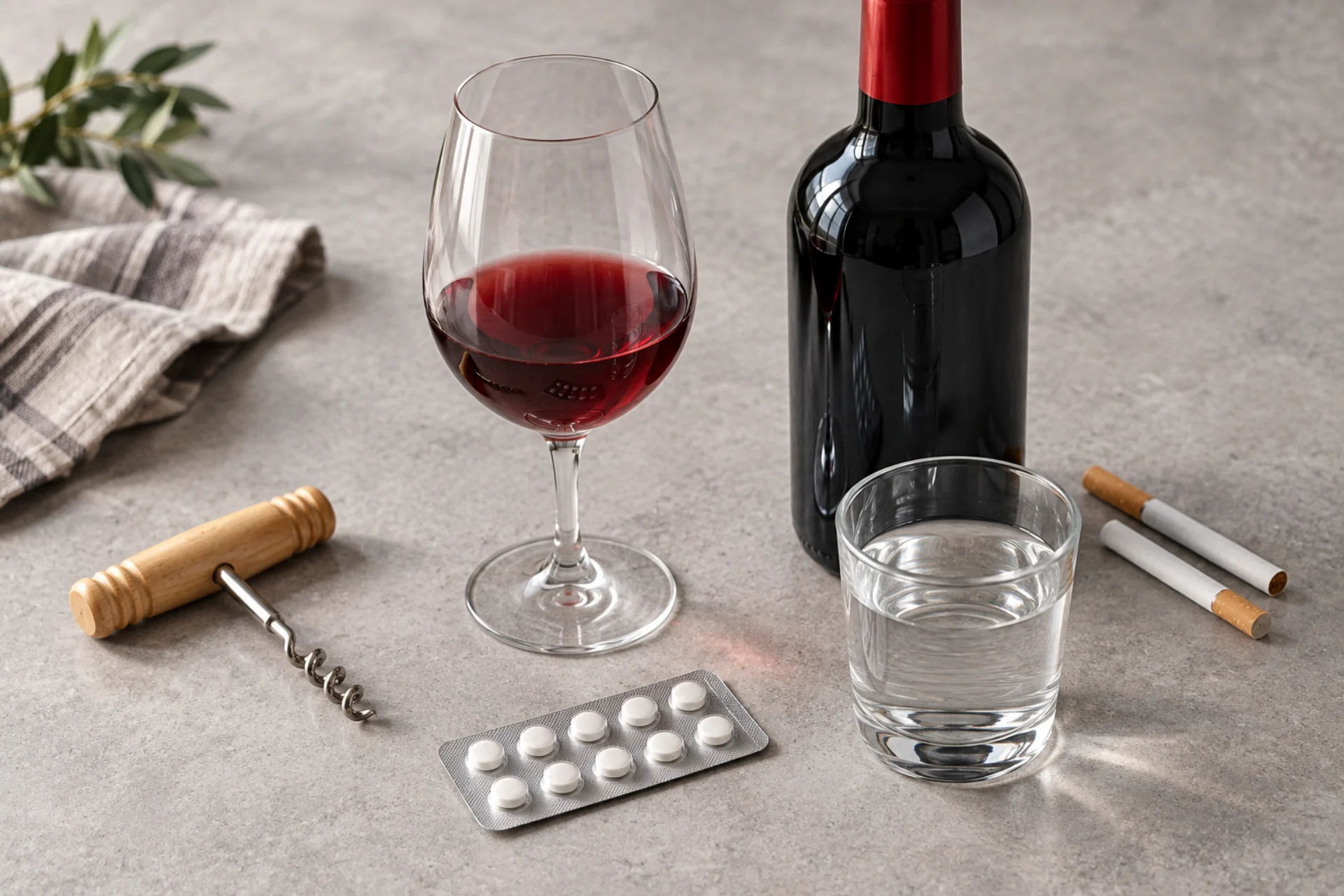
The product information for Desmoxan, Tabex and Recigar, the medicines that contain cytisine, does not describe any interaction with alcohol. This does not confirm that it is safe to drink during the course. You need to stop smoking by day 5 of the course at the latest. Among heavy drinkers who were trying to quit smoking, drinking alcohol often came just before the first cigarette smoked after quitting. People with a drinking problem should decide with their doctor whether to start a course of cytisine and how to combine it with treatment for alcoholism.
In brief
- The fact that the product information for Desmoxan, Tabex and Recigar tablets does not describe an interaction with alcohol does not confirm that it is safe to drink during the course.
- In a study of 236 heavy drinkers who were quitting smoking, more than 4 in 10 first lapses (the first cigarette smoked after quitting) happened while drinking alcohol. On days when participants drank moderate amounts of alcohol, the risk of smoking a cigarette was almost 4 times higher than on days without alcohol.
- You need to stop smoking by day 5 of the cytisine course at the latest. The US National Cancer Institute advises drinking less alcohol, or none at all, in the first weeks after quitting.
- Anyone who drinks heavily, has liver disease or is being treated for alcoholism, for example with disulfiram or naltrexone, should start a course of cytisine only after consulting a doctor.
What does the product information for Desmoxan and Tabex say about alcohol?
The summaries of product characteristics (SmPCs) for Desmoxan, Tabex and Recigar tablets, and the patient leaflets for these products, contain no information about alcohol. We checked the documents in Poland's official Register of Medicinal Products in October 2026. Ethyl alcohol is listed only among the ingredients of Recigar Active oral solution, as an excipient in a trace amount.
The section on interactions states that cytisine should not be used together with tuberculosis medicines and that there are no clinical data on other significant interactions. While you are taking Desmoxan or Recigar, smoking or using other nicotine products may make the side effects of nicotine worse. The products differ in details that matter for people who drink heavily or are being treated for alcohol dependence.
| Product and form | Alcohol in the SmPC | Interactions with other medicines | Impaired liver function |
|---|---|---|---|
| Desmoxan, tablets | not mentioned | do not combine with tuberculosis medicines; no data on other significant interactions | not recommended because of a lack of clinical experience |
| Desmoxan, capsules | not mentioned | with tuberculosis medicines (para-aminosalicylic acid, streptomycin), the stimulant effect of cytisine is weaker; no data on other interactions | in liver or kidney failure, the doctor weighs the benefits against the risks |
| Tabex, film-coated tablets | not mentioned | do not combine with tuberculosis medicines; no other data | use with caution in liver and kidney failure |
| Recigar, film-coated tablets | not mentioned | do not combine with tuberculosis medicines; no data on other significant interactions | not recommended because of a lack of clinical experience |
| Recigar Active, oral solution | 0.17 mg of ethanol per dose, less than in 1 ml of beer or wine | do not combine with tuberculosis medicines; no data on other significant interactions | not recommended because of a lack of clinical experience |
All these products contain the same active substance at a dose of 1.5 mg, and the course lasts 25 days. We describe the course day by day in our article on the cytisine course.
If the cytisine SmPC does not mention alcohol, does that mean you can drink?
No. The absence of a described interaction does not confirm that it is safe to drink alcohol while taking cytisine.
Cytisine reaches its highest level in the blood after just under an hour on average. The body breaks down only a small part of it, and 64% of the dose is excreted unchanged in the urine within a day. The half-life, meaning the time it takes for the level of the medicine in the blood to fall by half, is about 4 hours. These data are not enough, however, to judge whether drinking alcohol during the course is safe.
A study in St Petersburg looked at cytisine in people who drink. The study included 400 people living with HIV who smoked every day and often drank large amounts of alcohol. It tested whether cytisine helps people cut down on drinking, and according to the authors it was the first study of cytisine for this purpose. Some participants took cytisine for the standard 25 days. Side effects occurred at similar rates in all groups, and the researchers recorded no serious side effects related to the medicines (1). However, participants were given brief advice about drinking and smoking, and the study did not examine whether drinking during the course is safe. This result therefore cannot be generalised to everyone who takes cytisine and drinks alcohol.
Can you drink alcohol during treatment with bupropion?
Bupropion (Zyban), another medicine used to help people stop smoking, is contraindicated in people who abruptly stop drinking alcohol during treatment, because this increases the risk of seizures. There have also been rare reports of neuropsychiatric symptoms or reduced alcohol tolerance in people who drank during treatment. While taking Zyban, you should avoid alcohol or drink as little as possible.
Which side effects of cytisine are easy to confuse with the effects of drinking?
Very common side effects of Desmoxan include dry mouth, nausea, dizziness and headaches, a faster heartbeat, raised blood pressure and sleep disturbances. Dry mouth, nausea, a headache or disturbed sleep can also follow an evening of drinking, so the next day it is hard to tell which symptoms were caused by the medicine and which by the alcohol. If these symptoms are severe or do not go away, you need to talk to a doctor or pharmacist. Our article on the side effects of cytisine explains which symptoms come from the medicine and which from nicotine withdrawal.
Why is it so easy to smoke after drinking when you are trying to quit?
Alcohol strengthens the urge to smoke and makes it harder to resist, and many people have smoked for years over beer, wine or mixed drinks. In a study of heavy drinkers who were quitting smoking, more than 4 in 10 first lapses happened while drinking alcohol. The studies described below did not involve cytisine.
The US study included 236 people who were quitting smoking as part of a clinical trial and drank heavily, although they were not dependent on alcohol. During treatment, 178 of them lapsed, and 41.5% of these lapses happened while drinking alcohol, most often in a bar or restaurant, in company and in a good mood. On days when participants drank moderate amounts of alcohol, the risk of smoking a first cigarette after quitting was almost 4 times higher than on days without alcohol. On heavy drinking days, the risk was twice as high as on days of moderate drinking (2).
The same team studied in the laboratory how alcohol affects reaching for a cigarette. The study included 100 smokers who drank heavily. On three separate days, after 3 hours without a cigarette, they had a non-alcoholic drink or a lower or higher dose of alcohol, and were then paid for every minute they did not smoke. After the higher dose (0.8 g of alcohol per kilogram of body weight), they reached for a cigarette more than 6 minutes earlier on average than after the non-alcoholic drink. After the lower dose, the difference was more than 3 minutes, but it may have been due to chance. According to the authors, part of this effect is explained by a stronger urge to smoke after alcohol (3).
Studies of larger groups found similar results. Among 1504 people quitting smoking in a clinical trial, those who sometimes drank to the point of getting drunk lapsed more often than moderate drinkers (4). In a study following 4831 smokers from the UK, Canada, Australia and the US, people who drank at least 4 (women) or 5 (men) drinks on one occasion more often than once a week were less likely to quit. Of those who tried to quit, fewer managed to stay smoke-free for longer than a month (5).
What does it mean if you smoke while drinking after day 5 of a cytisine course?
You need to stop smoking by day 5 of the cytisine course at the latest. Once you have stopped smoking while taking Tabex, you must not smoke even a single cigarette, because the long-term success of treatment depends on it. Smoking while taking Desmoxan can also make side effects worse.
If the treatment is not working, you need to stop taking cytisine, and another course can be started after 2-3 months. Our article on smoking again after quitting explains what to do after smoking again and how to decide whether to continue treatment.
How can you lower the risk of smoking after drinking during a cytisine course?
The National Cancer Institute points out that it is harder to resist the urge to smoke under the influence of alcohol. In the first weeks after quitting, it advises drinking less alcohol or none at all. For those who still drink, it recommends choosing drinks other than the ones they used to have with a cigarette and avoiding places where they usually drank (6). It helps to plan the start of your cytisine course so that your quit day (day 5 of the course at the latest) and the following weeks do not coincide with a wedding, a birthday or a trip with friends. In Kahler's study, most lapses after drinking happened in company and in a good mood. This is why it is worth planning how to lower the risk of smoking even before a get-together you are looking forward to.
Can someone with a drinking problem take cytisine?
The SmPCs for medicines containing cytisine do not rule out its use in people with a drinking problem, and studies do not suggest that help with quitting smoking threatens abstinence from alcohol. A review covered 35 studies involving 5796 people who were being treated for, or had completed treatment for, alcohol or drug dependence. In the 11 studies that looked at this, help with quitting smoking did not change the proportion of people who stayed abstinent from alcohol and drugs. In these studies, stop-smoking medicines increased the number of people who did not smoke, although the authors rated the quality of the evidence as low (7). Even so, the medicine should be chosen after a consultation with a doctor, for two reasons.
The first reason is the condition of the liver. Desmoxan tablets and Recigar are not recommended for people with impaired liver or kidney function, and people with these conditions should take Tabex with caution. Uncommon side effects of these medicines include raised aminotransferases, the liver enzymes measured in a blood test. Drinking large amounts of alcohol over a long period can damage the liver, as we describe in our article on alcohol-related liver disease.
The second reason is the medicines used to treat alcoholism. The SmPCs for medicines containing cytisine do not mention disulfiram, naltrexone or acamprosate. Apart from the information on tuberculosis medicines, they state only that there are no data on other significant interactions. For people treated with disulfiram, including as an implant, the form in which cytisine is taken matters. A reaction with disulfiram can also be triggered by products containing small amounts of alcohol, such as mouthwashes or syrups. Ethanol is not listed among the ingredients of Desmoxan, Tabex or Recigar tablets, and Recigar Active solution contains a trace amount. A person treated with disulfiram should tell their doctor and pharmacist about it before choosing a product.
Our article on quitting drinking and smoking explains when to give up smoking and drinking at the same time and when to do it one after the other. If alcohol is the bigger problem for you right now, you can read how alcoholism treatment works at Nasz Gabinet on a separate page.
When should you talk to a doctor about drinking before starting cytisine?
Before starting the course, you need to talk to a doctor about your drinking if:
- you drink alcohol several times a week or in amounts that make you drunk
- a doctor has diagnosed liver disease or raised liver function test results
- your treatment for alcoholism includes medicines such as disulfiram, naltrexone or acamprosate, or you have had an implant for alcohol dependence
- you have recently had an alcohol detox or are currently in addiction treatment
- during a previous attempt to quit smoking, you smoked again after drinking alcohol
A stop-smoking medicine is chosen to suit your medical conditions, the medicines you take and the situations in which you reach for a cigarette, including those linked to alcohol. At Nasz Gabinet, nicotine dependence treatment starts with a medical interview. Once the doctor has assessed that the treatment is suitable for you, they issue an e-prescription for the chosen medicine. The three-month treatment plan also includes a module in the Nasz Gabinet app with dose reminders, a smoke-free day counter and a diary. If alcohol or stress makes it hard to stay smoke-free, you can also book a paid consultation with a psychologist in the app. This article does not replace a medical consultation.
Frequently asked questions
Is one beer dangerous while taking Tabex or Desmoxan?
No one can guarantee that drinking one beer while taking Tabex or Desmoxan will be safe. The risk of smoking again is better studied: in a study of heavy drinkers who were quitting smoking, the risk of a lapse on days of moderate drinking was almost 4 times higher than on days without alcohol. The National Cancer Institute advises drinking less alcohol or none at all in the first weeks after quitting. For those who still drink, it recommends choosing drinks other than the ones they used to have with a cigarette and avoiding places associated with drinking.
How long after the last cytisine tablet can you drink alcohol?
There is no established waiting time after the last cytisine tablet before it is safe to drink alcohol. The half-life of cytisine is about 4 hours, and 64% of the dose is excreted in the urine within a day. However, the urge to smoke after drinking does not disappear when the 25-day course ends. Our article on when the urge to smoke stops describes how long the urge to smoke keeps returning after quitting.
Does cytisine reduce the desire to drink?
There is no evidence that cytisine reduces the desire for alcohol in humans. In a study of 400 people living with HIV who drank and smoked heavily, participants in all groups drank less alcohol, and cytisine worked no better than nicotine replacement therapy. The authors write that their results do not justify using cytisine solely to drink less. The medicine is not authorised for this purpose.
Does alcohol make cytisine less effective?
The cytisine data in the SmPCs do not show whether alcohol changes the level or the effect of the medicine. However, studies in which cytisine was not used show that alcohol strengthens the urge to smoke. In a laboratory experiment, smokers who drank heavily reached for a cigarette more than 6 minutes earlier on average after a higher dose of alcohol than after a non-alcoholic drink.
What should I do if I smoked after drinking during the course?
If you smoked a cigarette after drinking during the course, it is best to go back to not smoking straight away and talk to a doctor or pharmacist about whether to keep taking cytisine. The course should be stopped if the treatment is not working; another course can be started after 2-3 months. It also helps to write down the circumstances in which you smoked: where it happened, who you were with and how much alcohol you had drunk. This makes it easier to anticipate a similar situation at your next get-together.
Sources
- Tindle HA, Freiberg MS, Cheng DM et al. Effectiveness of Varenicline and Cytisine for Alcohol Use Reduction Among People With HIV and Substance Use: A Randomized Clinical Trial. JAMA Netw Open. 2022;5(8):e2225129. PMID 35930287, DOI
- Kahler CW, Spillane NS, Metrik J. Alcohol use and initial smoking lapses among heavy drinkers in smoking cessation treatment. Nicotine Tob Res. 2010;12(7):781-785. PMID 20507898, DOI
- Kahler CW, Metrik J, Spillane NS et al. Acute effects of low and high dose alcohol on smoking lapse behavior in a laboratory analogue task. Psychopharmacology (Berl). 2014;231(24):4649-4657. PMID 24858377, DOI
- Cook JW, Fucito LM, Piasecki TM et al. Relations of alcohol consumption with smoking cessation milestones and tobacco dependence. J Consult Clin Psychol. 2012;80(6):1075-1085. PMID 22963593, DOI
- Kahler CW, Borland R, Hyland A et al. Alcohol consumption and quitting smoking in the International Tobacco Control (ITC) Four Country Survey. Drug Alcohol Depend. 2009;100(3):214-220. PMID 19056188, DOI
- National Cancer Institute. Handling Nicotine Withdrawal and Triggers When You Decide To Quit Tobacco. cancer.gov
- Apollonio D, Philipps R, Bero L. Interventions for tobacco use cessation in people in treatment for or recovery from substance use disorders. Cochrane Database Syst Rev. 2016;11(11):CD010274. PMID 27878808, DOI
- Charakterystyka Produktu Leczniczego Desmoxan, 1,5 mg, tabletki. Rejestr Produktów Leczniczych, rejestrymedyczne.ezdrowie.gov.pl
- Charakterystyka Produktu Leczniczego Desmoxan, 1,5 mg, kapsułki twarde. Rejestr Produktów Leczniczych, rejestrymedyczne.ezdrowie.gov.pl
- Charakterystyka Produktu Leczniczego Tabex, 1,5 mg, tabletki powlekane. Rejestr Produktów Leczniczych, rejestrymedyczne.ezdrowie.gov.pl
- Charakterystyka Produktu Leczniczego Recigar, 1,5 mg, tabletki powlekane. Rejestr Produktów Leczniczych, rejestrymedyczne.ezdrowie.gov.pl
- Charakterystyka Produktu Leczniczego Recigar Active, 1,5 mg/dawkę, roztwór doustny. Rejestr Produktów Leczniczych, rejestrymedyczne.ezdrowie.gov.pl
- Charakterystyka Produktu Leczniczego Zyban, 150 mg, tabletki powlekane o przedłużonym uwalnianiu. Rejestr Produktów Leczniczych, rejestrymedyczne.ezdrowie.gov.pl
- Charakterystyka Produktu Leczniczego Anticol, 500 mg, tabletki. Rejestr Produktów Leczniczych, rejestrymedyczne.ezdrowie.gov.pl
Quitting smoking and not sure whether you can drink alcohol?
In the Nasz Gabinet app, you can start a 3-month treatment plan. The medical interview covers your drinking and the medicines you take.