
Table of contents
Alcohol belly is the informal name for a large, protruding belly in someone who drinks alcohol regularly. In a Japanese study, men who drank more alcohol had more visceral fat on CT scans, meaning fat stored deep inside the abdomen, around the intestines, liver and pancreas. In someone who drinks, however, the belly can also grow because of gas in the intestines or because of fluid that collects in the abdominal cavity in severe liver disease (ascites). These three conditions differ in how the belly changes over time and in the symptoms that come with it. The diagnosis is made by a doctor after examining the abdomen, because appearance alone is not enough. How your belly measurement changes after you stop drinking depends on what is making the belly bigger, and appearance alone cannot tell you when it will get smaller.
In brief
- Drinking alcohol is linked to visceral fat, which surrounds the abdominal organs. In a Japanese study of almost a thousand men, those who drank more had more visceral fat regardless of BMI, while the amount of fat under the skin (subcutaneous fat) was not linked to drinking.
- One gram of alcohol provides 7 kcal. People usually eat more when they drink, and while the body is breaking down alcohol, it burns less fat.
- Bloating can change the size of your belly within a single day, fat builds up and comes off over months, and ascites is most often a complication of liver cirrhosis that needs prompt medical attention.
- In one study, abdominal exercises alone did not reduce belly fat. Visceral fat goes down when body weight falls, and regular exercise training reduces it even when your weight changes little.
What is an alcohol belly?
Alcohol belly is the informal name for abdominal obesity in someone who drinks alcohol regularly, meaning excess fat on the belly and around the abdominal organs. A doctor diagnoses abdominal obesity from your waist circumference.
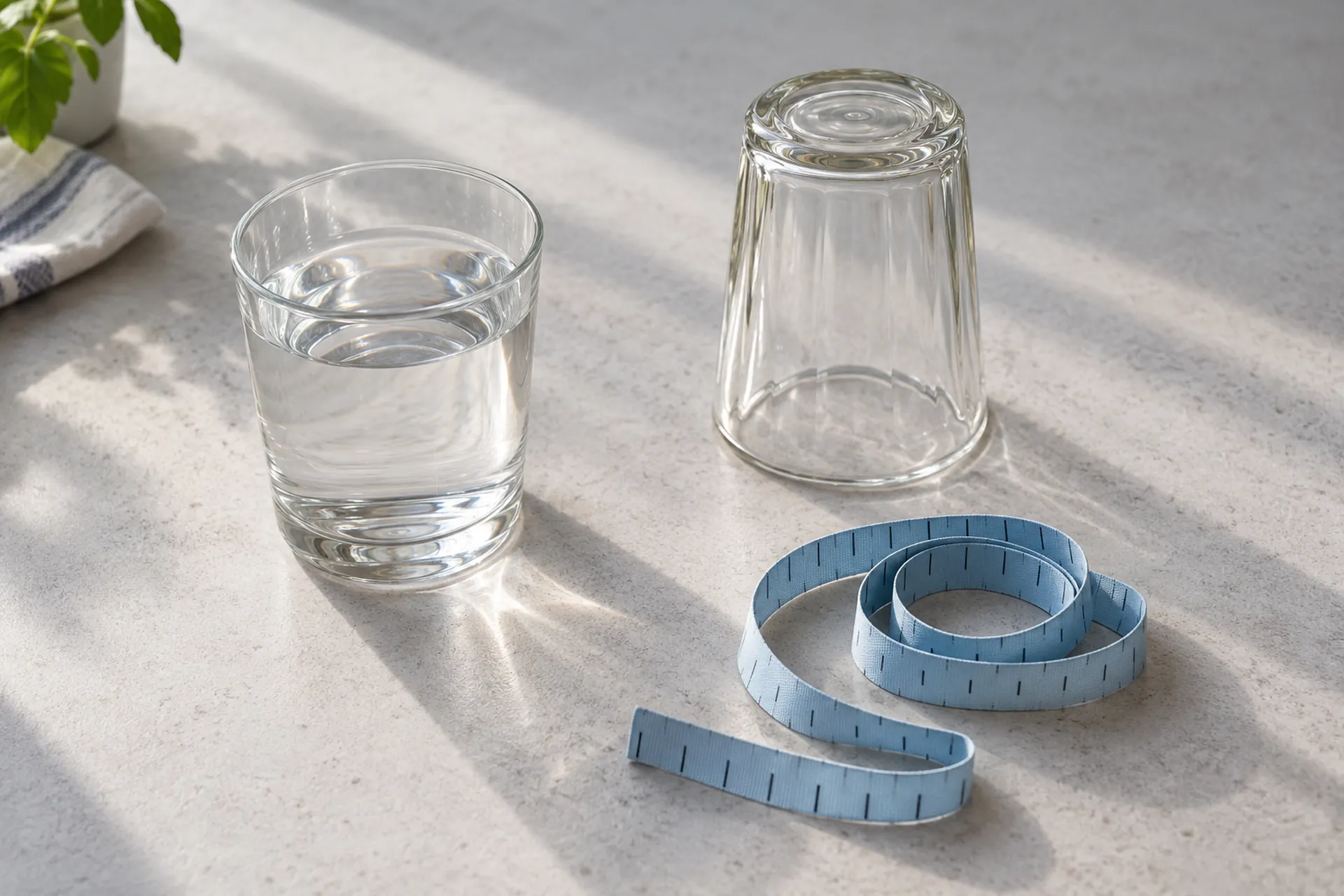
Belly fat is stored in two layers. Subcutaneous fat is the fat you can pinch between your fingers. Visceral fat lies deeper, beneath the abdominal muscles, and surrounds the abdominal organs. When there is a lot of it, the belly becomes round and protruding. The amount of visceral fat can be measured precisely with computed tomography (CT) or magnetic resonance imaging (MRI). For everyday purposes, an indirect measurement is enough: waist circumference is measured with a flexible tape measure halfway between the lowest rib and the top of the hip bone. According to the guidelines of the Polish Society for the Treatment of Obesity (PTLO), abdominal obesity is diagnosed when the waist measures at least 80 cm in women and 94 cm in men (2).
Visceral fat releases substances that sustain low-grade inflammation and makes the body less sensitive to insulin. This is why it raises the risk of prediabetes and type 2 diabetes. People whose CT or MRI scans show a lot of visceral fat are more likely to develop cardiovascular and metabolic diseases and more likely to die from them, even after other risk factors are taken into account (1).
Is an alcohol belly hard?
A belly with a lot of visceral fat can feel hard, because this fat lies beneath the abdominal muscles and cannot be pinched. Hardness, however, does not tell you the cause. Bloating also causes a feeling of tightness and pressure in the belly, and a large amount of fluid in the abdominal cavity makes the belly visibly distended, so the cause can only be established by a doctor's examination.
Why does drinking alcohol make your belly bigger?
Alcohol is high in calories, encourages you to eat larger portions and reduces fat burning for several hours. In men, excess fat is stored on the belly more often than in women.
One gram of pure alcohol provides 7 kcal (4). Calories from alcohol add to the calories from food, and alcohol drunk before or with a meal usually makes people eat more (5).
As long as there is alcohol in your blood, your body burns less fat. In one study, eight healthy men twice spent two days in a metabolic chamber that recorded what their bodies were burning. When they were given about 96 g of alcohol a day (a quarter of their daily energy needs) on top of their usual food, they burned 36% less fat over the day. They burned less fat only during the hours when they were drinking alcohol and their bodies were breaking it down (6). In another study, also of eight men, after drinking 24 g of alcohol (roughly the amount in a half-litre of 6% beer), their bodies burned 73% less fat over the following hours. The liver converted most of the alcohol into acetate, which the tissues used as fuel instead of fat. Less than 5% of the alcohol was converted directly into fat (7). The authors of the first study concluded that alcohol drunk regularly, when it supplies more energy than the body needs, probably promotes fat storage and weight gain.
Japanese researchers looked at whether people who drink more have more visceral fat. They measured it with CT in 998 men aged 40 to 79. Those who drank more alcohol per week had more visceral fat and a larger waist circumference, even after BMI was taken into account. The amount of subcutaneous fat was not linked to how much they drank (8). This was a cross-sectional study, meaning that a group of people was examined at a single point in time, so it shows an association but does not prove that alcohol was the cause.
Does beer give you a beer belly?
Men who drink a lot of beer are more likely to see their waist circumference increase, but in a large study this was mainly due to overall weight gain. The study did not confirm that beer makes fat settle specifically on the belly.
In the German EPIC-Potsdam study, 7,876 men and 12,749 women were followed for 8.5 years. Men who drank a litre of beer a day had a 17% higher risk of their waist circumference increasing than those who drank very little beer. Most of this association, however, was explained by overall weight gain, and the authors concluded that the results do not support a separate effect of beer on the belly (9).
How can you tell an alcohol belly from bloating and ascites?
Visceral fat builds up and comes off slowly, along with body weight. Bloating can change the size of your belly even within a single day. Ascites is fluid in the abdominal cavity, most often in liver cirrhosis, and needs prompt medical attention. A doctor identifies the cause by examining your abdomen and, if in doubt, with an ultrasound scan.
| Feature | Visceral fat | Bloating | Ascites |
|---|---|---|---|
| What makes the belly bigger | Fat around the abdominal organs | Gas and the contents of the intestines | Fluid in the abdominal cavity, most often in liver cirrhosis |
| How it changes over time | Grows and shrinks over months, along with body weight | With chronic bloating, often mildest in the morning and at night, worst after meals and in the early evening | In someone with cirrhosis, the appearance of ascites means the disease has become decompensated. A small amount of fluid can only be seen on ultrasound, a moderate amount causes even swelling of the belly, and a large amount makes it visibly distended |
| What comes with it | Weight gain, a waist of 80 cm or more in women and 94 cm or more in men | A feeling of gas, fullness and pressure, constipation, food intolerances and, in some women, the days around their period | It may come with other symptoms of liver disease, such as swollen legs, yellowing of the skin and eyes, and easy bruising |
| What to do | A routine appointment with a doctor, a waist measurement and blood tests | See a doctor if bloating keeps coming back or does not go away after changing what you eat | An urgent appointment with a doctor, who will order an abdominal ultrasound and blood tests |
What causes bloating after alcohol?
Bloating is a feeling of gas, fullness or pressure in the belly. In some people the belly really does get bigger, while in others its size does not change. With chronic bloating, symptoms are often mildest in the morning and at night and worst after meals and in the early evening (10). Bloating is more likely with fizzy drinks, certain vegetables, swallowing air while eating, constipation and food intolerances. People who are often bloated are also advised to cut down on alcohol (11). Beer, of course, is both alcoholic and fizzy. If you also get abdominal pain after drinking, we describe its causes in our article on abdominal pain after alcohol.
What is alcohol-related ascites?
Ascites is fluid that collects in the abdominal cavity. In Western countries, about 80% of cases are caused by liver cirrhosis. It is the most common serious complication in people with cirrhosis: each year it develops in 5-10% of those whose disease had not caused any complications before (3). We describe its symptoms, diagnosis and treatment in our article on alcohol-related ascites.
Can you recognise an alcohol belly from a photo?
No. A photo does not show what is making the belly bigger: fat, gas or fluid. Nor does it show how the belly changes during the day or what symptoms come with it. A doctor assesses the belly by taking your history and examining you, and if fluid is suspected, orders an abdominal ultrasound and blood tests that show how well your liver and kidneys are working.
What does an alcohol belly look like in women?
Before the menopause, women tend to store excess fat on the hips, buttocks and thighs. During the menopause, visceral fat increases, so the belly may start to grow. In women, abdominal obesity is diagnosed when the waist measures 80 cm or more.
Fat stored on the buttocks and thighs is linked to a lower risk of heart and metabolic disease than the abdominal obesity typical of men (12). During the menopause, this pattern changes. Researchers followed 156 women for four years. With age, all of them gained subcutaneous fat, but a marked increase in visceral fat occurred only in those who went through the menopause during that time (13).
In the EPIC-Potsdam study, a larger waist circumference in people who drank more beer was seen at the start of follow-up only in men. In women, over the following years, waist circumference increased less often in those who did not drink beer at all than in those who drank very little (9). Women's risk of alcohol-related liver disease rises at lower amounts of alcohol than men's (14). Some women also feel bloated around their period. A woman who drinks regularly and notices her belly growing should measure her waist and ask her doctor about liver function tests.
How long does it take for an alcohol belly to go away?
Bloating eases once its cause has passed, sometimes on the same day. Visceral fat goes down along with body weight, so changes in your waist measurement take weeks and months. With modest weight loss, however, you lose proportionally more visceral fat than subcutaneous fat.
In a study of people who drank heavily but were not dependent and had no liver disease, after a month without alcohol their body weight fell by an average of 1.5% and their insulin resistance by about a quarter. Waist circumference was not measured in this study (15).
The authors of a review of 61 studies in which fat was measured with imaging before and after weight loss found that with modest weight loss, proportionally more visceral fat is lost than subcutaneous fat. The more weight participants lost, the smaller this advantage became (16). Fatty liver, which is common in heavy drinkers, can clear up completely after a few weeks without alcohol (14).
We explain how many kilograms you can lose after giving up alcohol, and why some people gain weight at first, in our article on how much weight you can lose after you stop drinking.
Someone who drinks heavily every day or is on a drinking binge should not stop drinking suddenly on their own. In that situation, stopping abruptly can cause withdrawal syndrome and, in more severe cases, seizures and delirium tremens (17). In that case, drinking should be stopped under medical supervision, as part of alcohol detox. We describe the symptoms of alcohol withdrawal and how long they last in our article on alcohol withdrawal syndrome.
How do you get rid of an alcohol belly?
An alcohol belly can get smaller after you stop drinking, as your body weight falls. Regular exercise training reduces visceral fat even with little weight loss, while in one study abdominal exercises alone reduced neither belly fat nor belly circumference.
The authors of a review of 117 studies involving 4,815 people compared the effects of a calorie-restricted diet and exercise training on visceral fat. Participants lost more weight with diet, but slightly more visceral fat with exercise, although this difference was not statistically significant. When weight did not change, visceral fat went down by 6.1% with exercise and by only 1.1% with diet (18). In another study, 24 people were randomly assigned to two groups. For 6 weeks, both groups ate the same as before, but only one of them did seven abdominal exercises 5 times a week. The exercises reduced neither belly fat nor belly circumference and only improved muscle endurance (19).
Scales do not always show how much visceral fat you have lost, so it is better to track your progress with a tape measure as well. Measure your waist once a month, in the same place and at the same time of day, for example in the morning before eating. In people with chronic bloating, the belly is often bigger after meals and in the evening.
If your waist measures at least 80 cm (for a woman) or 94 cm (for a man), it is a good idea to show these measurements to a doctor. Obesity is a chronic disease. The doctor assesses whether, in addition to changes in eating and physical activity, you need an obesity medicine. At Nasz Gabinet, we provide obesity treatment as a 6-month online programme: the doctor checks your BMI, waist circumference and blood test results and decides whether to prescribe a medicine based on PTLO criteria. The doctor prescribes it by e-prescription and you buy it separately at a pharmacy. Medical check-ups take place every month, based on the weigh-ins and body measurements you enter in the app. If a patient's drinking is hazardous, we also refer them, alongside the programme, to our addiction treatment clinic for alcohol addiction treatment.
When does a large belly in someone who drinks need urgent medical attention?
Symptoms that may point to liver, pancreatic or bowel disease need urgent help. Go to hospital straight away if you have blood in your vomit, black stools, sudden confusion, sudden severe abdominal pain or severe breathlessness. See a doctor the same day if your skin or eyes turn yellow, your legs swell, or bloating comes with pain, fever or vomiting. If your belly grows gradually as your weight goes up and you have no warning signs, book a routine appointment with a doctor. If you have been diagnosed with liver cirrhosis and your belly is getting bigger, you need an urgent consultation (20).
When should you go to the emergency department with a swollen belly?
Go straight to a hospital emergency department (SOR) or call an ambulance if you have:
- vomiting blood or vomit that looks like coffee grounds
- very dark or black stools
- sudden confusion or slurred speech
- sudden, severe abdominal pain, especially pain that spreads to your back
- severe breathlessness
You should not drive yourself to hospital in this situation (11, 20, 21).
When should you see a doctor the same day about a swollen belly?
You need to see a doctor the same day if:
- your skin or the whites of your eyes turn yellow
- your belly is growing and at the same time your legs, ankles or feet are swelling
- you become breathless, or more breathless than usual
- bloating comes with abdominal pain, fever or chills, vomiting, diarrhoea or constipation
- you can feel a lump or a hard area in your abdomen
- you cannot pass urine, stools or wind (11, 20)
In someone with ascites, fever or abdominal pain can mean an infection of the fluid in the abdominal cavity, which needs prompt treatment (3).
When is a routine appointment enough for an alcohol belly?
Book a routine appointment if your belly is growing slowly along with your weight, you have no warning signs and your waist measures at least 80 cm (for a woman) or 94 cm (for a man). This does not apply to an enlarging belly in someone diagnosed with liver cirrhosis, which needs an urgent consultation. You should also see a doctor if bloating keeps coming back or comes with weight loss you cannot explain by dieting, or with blood in your stools (11). The doctor will measure your blood pressure and waist and order blood tests, including the liver function tests ALT and AST, glucose and a lipid profile, and, if needed, an abdominal ultrasound. We list all the tests in our article on tests before obesity treatment. This article does not replace a medical consultation.
Frequently asked questions
Is an alcohol belly a sign of alcoholism?
A belly alone is not enough to diagnose dependence. A large belly can be caused by excess fat, bloating or ascites, and on its own it says nothing about how much someone drinks. Dependence is diagnosed from other symptoms, including loss of control over drinking and withdrawal symptoms. We explain how to tell a daily habit from dependence in our article on whether one beer a day is alcoholism. If your belly keeps growing and you cannot stop drinking even though you have decided to, it is a good idea to talk to a doctor or an addiction therapist.
Will an alcohol belly go away if I switch from beer to wine or vodka?
Switching from beer to wine or vodka does not guarantee a smaller belly. One gram of alcohol provides 7 kcal whether it comes from beer, wine or vodka, and in the Japanese study, the more alcohol the men drank in total, the more visceral fat they had. Your belly may get smaller after you stop drinking, if your body weight falls.
Is an alcohol belly bad for your health?
Yes. Abdominal obesity, meaning a waist of 80 cm or more in women and 94 cm or more in men, increases the risk of cardiovascular disease, and visceral fat promotes insulin resistance and type 2 diabetes. In someone who drinks, the risk of alcohol-related liver disease also rises, and the more they drink, the higher it is. If the belly is enlarged by fluid (ascites), this is most often a complication of liver cirrhosis that needs an urgent appointment with a doctor.
Sources
- Neeland IJ, Ross R, Després JP et al. Visceral and ectopic fat, atherosclerosis, and cardiometabolic disease: a position statement. Lancet Diabetes Endocrinol. 2019;7(9):715-725. PMID 31301983, DOI
- Polskie Towarzystwo Leczenia Otyłości (Polish Society for the Treatment of Obesity). Zalecenia kliniczne dotyczące postępowania u chorych na otyłość 2024 (Clinical guidelines for the management of patients with obesity). Medycyna Praktyczna, special edition, September 2024. ptlo.org.pl
- European Association for the Study of the Liver. EASL Clinical Practice Guidelines for the management of patients with decompensated cirrhosis. J Hepatol. 2018;69(2):406-460. PMID 29653741, DOI
- Traversy G, Chaput JP. Alcohol Consumption and Obesity: An Update. Curr Obes Rep. 2015;4(1):122-130. PMID 25741455, DOI
- Yeomans MR. Alcohol, appetite and energy balance: is alcohol intake a risk factor for obesity? Physiol Behav. 2010;100(1):82-89. PMID 20096714, DOI
- Suter PM, Schutz Y, Jequier E. The effect of ethanol on fat storage in healthy subjects. N Engl J Med. 1992;326(15):983-987. PMID 1545851, DOI
- Siler SQ, Neese RA, Hellerstein MK. De novo lipogenesis, lipid kinetics, and whole-body lipid balances in humans after acute alcohol consumption. Am J Clin Nutr. 1999;70(5):928-936. PMID 10539756, DOI
- Sumi M, Hisamatsu T, Fujiyoshi A et al. Association of Alcohol Consumption With Fat Deposition in a Community-Based Sample of Japanese Men: The Shiga Epidemiological Study of Subclinical Atherosclerosis (SESSA). J Epidemiol. 2019;29(6):205-212. PMID 29848904, DOI
- Schütze M, Schulz M, Steffen A et al. Beer consumption and the 'beer belly': scientific basis or common belief? Eur J Clin Nutr. 2009;63(9):1143-1149. PMID 19550430, DOI
- Mari A, Abu Backer F, Mahamid M et al. Bloating and Abdominal Distension: Clinical Approach and Management. Adv Ther. 2019;36(5):1075-1084. PMID 30879252, DOI
- NHS. Bloating. nhs.uk
- Karastergiou K, Smith SR, Greenberg AS et al. Sex differences in human adipose tissues - the biology of pear shape. Biol Sex Differ. 2012;3(1):13. PMID 22651247, DOI
- Lovejoy JC, Champagne CM, de Jonge L et al. Increased visceral fat and decreased energy expenditure during the menopausal transition. Int J Obes (Lond). 2008;32(6):949-958. PMID 18332882, DOI
- European Association for the Study of the Liver. EASL Clinical Practice Guidelines: Management of alcohol-related liver disease. J Hepatol. 2018;69(1):154-181. PMID 29628280, DOI
- Mehta G, Macdonald S, Cronberg A et al. Short-term abstinence from alcohol and changes in cardiovascular risk factors, liver function tests and cancer-related growth factors: a prospective observational study. BMJ Open. 2018;8(5):e020673. PMID 29730627, DOI
- Chaston TB, Dixon JB. Factors associated with percent change in visceral versus subcutaneous abdominal fat during weight loss: findings from a systematic review. Int J Obes (Lond). 2008;32(4):619-628. PMID 18180786, DOI
- Jesse S, Bråthen G, Ferrara M et al. Alcohol withdrawal syndrome: mechanisms, manifestations, and management. Acta Neurol Scand. 2017;135(1):4-16. PMID 27586815, DOI
- Verheggen RJHM, Maessen MFH, Green DJ et al. A systematic review and meta-analysis on the effects of exercise training versus hypocaloric diet: distinct effects on body weight and visceral adipose tissue. Obes Rev. 2016;17(8):664-690. PMID 27213481, DOI
- Vispute SS, Smith JD, LeCheminant JD et al. The effect of abdominal exercise on abdominal fat. J Strength Cond Res. 2011;25(9):2559-2564. PMID 21804427, DOI
- NHS. Cirrhosis. nhs.uk
- NHS. Acute pancreatitis. nhs.uk
Is your belly growing and your waist above the normal range?
In the obesity treatment programme, the doctor checks your BMI, waist circumference and test results, and medical and psychological consultations take place by video in the app. If your drinking is hazardous, we also refer you to our addiction treatment clinic at the same time.