

How does nicotine dependence treatment in Radom work?
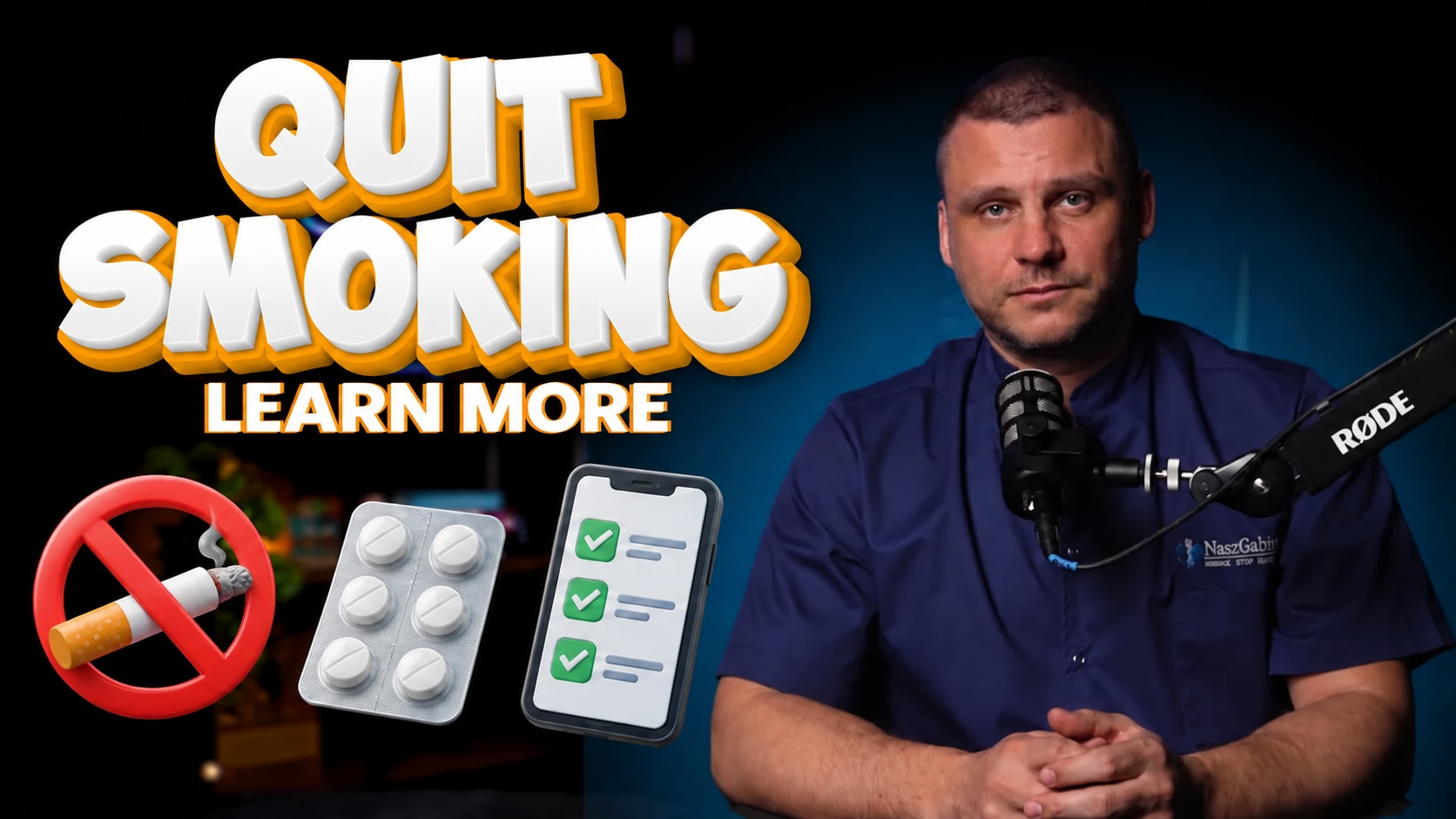
Nicotine dependence treatment in Radom starts with a medical appointment, after which the patient takes a medicine and meets an addiction therapist. No referral is needed. Nasz Gabinet Radom at Józefa Mireckiego 10 sees patients every day from 8:00 to 20:00, including Saturdays and Sundays.
What happens at the first appointment?
The appointment costs PLN 250 and takes place at the practice or by video call. The doctor asks how many cigarettes the patient smokes and how soon after waking they reach for the first one, as well as about chronic conditions, current medicines and previous attempts to quit. The doctor then chooses a medicine, writes out its doses for the following days and, together with the patient, sets the day from which the patient no longer smokes.
What happens between appointments?
Pharmacies sell cytisine and nicotine medicines without a prescription, so treatment can start straight after the appointment. At the same time, the patient meets an addiction therapist online. Each session costs an additional PLN 250. In the sessions, the patient lists the situations in which they usually light up and decides what they will do instead of reaching for a cigarette. If the patient buys the treatment programme, the Nasz Gabinet app reminds them when each dose is due.
What is the follow-up appointment for?
At the follow-up appointment, the doctor checks whether the patient has stopped smoking, how they are tolerating the medicine and whether nicotine cravings are easing. If the medicine causes side effects, the doctor may lower the dose or switch to a different medicine. Like the first appointment, the follow-up can take place at Mireckiego 10 or online. We write more about working with a therapist in our description of addiction therapy in Radom.
Does the urge to smoke go away after years without cigarettes?
The urge to smoke weakens over time, but in some former smokers it comes back even after many years. Nicotine withdrawal symptoms usually pass within a few weeks, whereas the link between cigarettes and coffee, stress or meeting friends lasts much longer.
Most people who go back to smoking do so in the first year, but relapses also happen later. American researchers pooled 8 clinical trials of nicotine medicines that checked whether participants who were not smoking after one year were still not smoking after 2 years or more. By their calculations, about 10 percent of these people went back to smoking in each subsequent year. There were few participants, however, so the true figure could have been anywhere from 5 to 17 percent.
An American survey that asked the same adults about smoking twice, about 3 years apart, gave a similar picture. Of those who, at the first survey, had not smoked for a year or less, more than half went back to smoking. In people with a longer break, the risk of relapse fell with each additional year without cigarettes, but never dropped to zero. After 30 years without smoking, it was about 10 percent. People who had quit at a younger age were more likely to start smoking again.
That is why the treatment plan also covers the time after the last dose of medicine. With an addiction therapist, the patient prepares for occasions when the urge to smoke may return months later, for example a wedding, a holiday or a difficult period at work. If they light up after a long break, they contact the practice, and the doctor assesses whether another course of treatment is needed.
How do stop-smoking medicines work and how much does a day of treatment cost?
Cytisine and nicotine medicines can be bought without a prescription. Both groups of medicines reduce nicotine cravings, but they differ in how they work, how long treatment lasts and how much a day costs. Effectiveness figures come from the 2023 Cochrane review, which covered 319 clinical trials with 157,179 participants. Cochrane is an international network of researchers that gathers the studies on a given topic and assesses their results together. We checked prices in pharmacies in September 2026.
In the Cochrane review, the effectiveness of medicines was assessed on the basis of not smoking after at least six months. The differences given come from comparing treatment with placebo or no medicine.
How does cytisine work?
Cytisine, sold as Desmoxan, Tabex and Recigar, binds to the same brain receptors as nicotine and stimulates them more weakly, so it eases withdrawal symptoms and reduces the pleasure felt after smoking a cigarette. The course lasts 25 days, and the daily number of tablets falls from 6 to 1 or 2. Smoking must stop by day 5 of treatment. With cytisine, the chance of quitting was more than twice as high as without medication, which means about 7 extra non-smokers for every 100 treated. One pack of 100 tablets is enough for the whole course and cost from about PLN 40 to PLN 78, so a day of treatment costs from PLN 1.60 to about PLN 3.10.
How does a nicotine patch work?
A patch, for example NiQuitin Przezroczysty or Nicorette Invisipatch, continuously releases a small dose of nicotine through the skin, so cravings are weaker for as long as the patch is worn. The NiQuitin patch is worn around the clock, while Invisipatch is worn for 16 hours and removed at night. With NiQuitin patches, a person who smokes more than 10 cigarettes a day applies a 21 mg patch for 6 weeks, then a 14 mg patch for 2 weeks and a 7 mg patch for the last 2 weeks. A patch alone increased the chance of quitting by about a third, that is, by about 2 extra non-smokers per 100 treated. NiQuitin patches for the whole course cost from about PLN 606 to PLN 930, which works out at about PLN 8.70 to PLN 13.30 a day.
When are nicotine gum, spray or lozenges used?
Nicorette Classic Gum with 2 or 4 mg of nicotine, Nicorette Spray with 1 mg of nicotine per dose and NiQuitin MINI lozenges with 1.5 or 4 mg of nicotine release nicotine in the mouth, from where it quickly passes into the blood. The patient uses these medicines when they suddenly feel the urge to smoke. No more than 2 sprays can be used at a time, 4 within an hour and 64 within 24 hours. When used without a patch, no more than 15 pieces of gum or lozenges can be used a day. For fast-acting forms of nicotine, the combined result was about 3 extra non-smokers per 100 compared with placebo or no medicine. A patch combined with one of these forms of nicotine gave a result close to that of cytisine treatment. The daily cost depends on how many doses the patient uses. One spray from a 150-dose pack cost from about 41 to 57 grosz, and one piece of 4 mg gum from a pack of 105 from about 74 to 95 grosz.
Can you get varenicline or bupropion?
Varenicline, the active substance in Champix, works in a similar way to cytisine and helped about 8 extra people per 100 treated to quit. Bupropion, the active substance in Zyban, is an antidepressant that helped about 3 extra people per 100 treated to quit. Both medicines require a prescription. Zyban disappeared from the market after its authorisation expired at the end of 2023, and none of the pharmacies we checked in September 2026 offered Champix. The doctor in Radom therefore chooses between cytisine and nicotine medicines, taking the patient's conditions and medicines into account, and we combine every course of treatment with sessions with an addiction therapist.
Does smoking weaken erections?
Smoking increases the risk of erectile dysfunction. An erection requires healthy blood vessels that dilate quickly and fill the erectile tissue of the penis with blood. Tobacco smoke damages the endothelium, the layer lining the inside of blood vessels, and makes it harder for them to dilate.
In an analysis of 8 studies involving 28,586 men, the authors considered the 4 studies that followed participants over several years to be the most reliable. These showed that smokers had about a 50 percent higher risk of erectile dysfunction than non-smokers, and former smokers about a 30 percent higher risk. In another analysis of 10 studies involving 50,360 men, the risk rose with the number of cigarettes and years of smoking. Every additional 10 cigarettes a day and every further 10 years of smoking increased the risk of erectile dysfunction by 14 to 15 percent.
Erections can improve after quitting smoking. An Iranian study followed 281 smokers with erectile dysfunction for a year, after other common causes such as high blood pressure and diabetes had been ruled out. All of them had come for nicotine medicines to help them quit. Improvement was found in at least 25 percent of the 118 men who quit and in none of the 163 men who kept smoking. Erections improved less in older men and in those with more severe dysfunction. In an American study, 65 men quit smoking using nicotine patches and taking part in supportive counselling. Four weeks after treatment, men who were not smoking had a stronger penile response to sexual stimuli in a laboratory measurement than men who had gone back to smoking.
Erectile dysfunction can also have other causes, such as diabetes, high blood pressure or the effects of some medicines. A patient who has such difficulties tells the doctor about them at the appointment. The doctor then asks about other conditions and medicines and assesses whether further tests are needed.
What happens in the app when a patient forgets a dose?
The treatment plan agreed at the practice is entered into the Nasz Gabinet app, which sends a notification when each dose is due. The patient confirms taking a cytisine tablet or applying a patch with a single tap. Once a day, the app asks for a recording of a randomly chosen dose being taken. The recordings are reviewed by medical staff. The use of gum, spray and lozenges, which the patient reaches for when a craving strikes, is not recorded.
If the patient does not confirm a dose, the app reminds them again a few hours later. If the dose is still unconfirmed, the practice sends a text message, which gets through even when notifications are turned off. Medical staff can see missed doses and may call the patient to check whether the gap is due to side effects of the medicine.
The app is free to download, and the fee covers the treatment programme that the practice runs in it. We will start the programme during your appointment at Mireckiego 10. You can also call the practice, and we will help you install the app and link it to your treatment plan.
Which methods do we not use to help people quit smoking?
- We do not recommend herbal cigarettes. They contain no tobacco or nicotine, but they are smoked like ordinary cigarettes, so smoke from burning plants reaches the lungs, along with carbon monoxide and tar. We have found no studies showing that they help people quit smoking. American researchers reviewed the descriptions of 51 herbal cigarettes in a large online shop and found claims that they help people quit in 78 percent of the descriptions, even though no authority had approved such claims. Herbal cigarettes also keep up the habit of holding a cigarette between the fingers and inhaling smoke.
- We do not advise switching from cigarettes to a pipe or cigars. A British study followed 21,520 men. Those who switched from cigarettes to a pipe or cigars were less likely to die of lung cancer, coronary heart disease and chronic obstructive pulmonary disease than men who kept smoking cigarettes. However, their risk of death from these diseases was 57 percent higher than in men who had quit smoking more than 20 years earlier, and 68 percent higher than in men who had never smoked. Judging by carbon monoxide levels in the blood, men who had previously smoked cigarettes inhaled pipe and cigar smoke more deeply than those who had only ever smoked a pipe or cigars.
Why start nicotine dependence treatment in Radom?
With every year without cigarettes, the risk of an abdominal aortic aneurysm decreases. An aneurysm is a widening of the aorta, the largest artery in the body, in the section that runs through the abdomen. It usually causes no symptoms until it ruptures, and a rupture causes internal bleeding that is often fatal.
In an analysis of 23 studies that followed people without an aneurysm over many years, smokers developed an abdominal aortic aneurysm almost 5 times as often as people who had never smoked, and former smokers about 2 times as often. The risk rose with the number of cigarettes, by 87 percent for every 10 cigarettes a day. Every 10 years since quitting reduced it by more than half, and after about 25 years the risk was similar to that of people who had never smoked.
Throughout treatment, patients of Nasz Gabinet Radom can rely on a doctor, an addiction therapist and medical staff. The doctor chooses the medicine and changes the plan if it causes side effects or cravings do not ease. The addiction therapist prepares the patient for difficult moments, including those that come after months without cigarettes. The app reminds the patient about doses, and if they miss one, the medical staff know about it. An appointment at Mireckiego 10 or online can be booked for any day of the week.