
Table of contents
Poland is among the European leaders in statistics on psychoactive substance use by teenagers - 6.4% of fifteen- and sixteen-year-olds have tried novel psychoactive substances, which puts Poland in first place in Europe (ahead of Slovenia at 6%), and 3.1% have had contact with methamphetamine - here too we rank first on the continent. Cannabis remains the most commonly used illegal substance in this age group, and its availability is growing - classic dried herb is increasingly giving way to THC oils in disposable vapes, bought from a dealer through a messaging app or ordered online. These numbers translate into specific classrooms, courtyards and bedrooms - and the parent is usually the last to find out. A single set of red eyes, a closed bedroom door or late-night messaging mean nothing on their own - a teenager has a right to privacy, often gets tired from school and lives to a different rhythm than adults. The problem begins where the signs accumulate and persist for weeks, and a child who six months ago talked about their day now avoids eye contact. This guide describes what the parent of a child using drugs sees - from pupil size, through objects in the room, to changes at school - and explains step by step what to do when the suspicions are confirmed.
In brief
- A single sign is not enough to make a diagnosis. Only five or six symptoms that persist for several weeks alongside a change in the child's personality call for a parent's response. Red eyes, a closed door or falling grades do not in themselves indicate drug use.
- The symptoms fall into three categories: physical, behavioural and environmental. Physical ones are the pupils (dilated to 6-8 mm with stimulants, constricted to 1-3 mm with opiates), red eyes, smell on the hair and clothes, problems with coordination. Behavioural ones are isolation, aggression or apathy, new older acquaintances, falling grades. Environmental ones are paraphernalia in the room and money disappearing from the home. The more categories overlap at once, the more urgent the response.
- Every substance leaves different traces - and they are not the same traces. Smoked cannabis smells sweet and grassy, gives red whites of the eyes and a dry mouth - THC oils from disposable vapes are almost odourless, which is why they have become the most popular form among teenagers today. Mephedrone dilates the pupils to 6-8 mm, winds the child up into talking and takes away sleep. Novel psychoactive substances are the hardest - the composition may be unknown even to the person taking them, so the symptoms can be contradictory: now agitation, now disorientation. Opiates are rare in teenagers, but tramadol from the medicine cabinet does happen - then the pupils constrict to 1-3 mm, the child is drowsy and scratches their skin.
- You need to react quickly, but not hysterically - panic shuts down the conversation. First a calm conversation based on specific observations, not accusations. Then a consultation with a child and adolescent psychiatrist or at an addiction treatment clinic - services reimbursed by the National Health Fund (NFZ), no referral needed. If the public queue is long, a first private appointment is worth considering as a faster way to assess the situation.
Why teenagers reach for drugs
A teenager reaches for drugs most often not out of rebellion or family dysfunction, but out of a desire to fit in with the group. The first contact with cannabis usually falls between the ages of 14 and 17, at a friend's party - the child does not plan to use, they simply cannot say no. The second reason is curiosity, fuelled by social media, where drugs are sometimes part of party aesthetics or a rapper's image. The third is emotional regulation: anxiety before final exams, loneliness, low self-esteem. A conscious recreational choice comes only in fourth place. The practical conclusion for a parent is this - a child does not fall into drug use because of a bad friend, but through a lack of skills in saying no and naming emotions that no one managed to teach them earlier. This changes the way you talk: instead of bans, it is worth rehearsing specific situations in which it is hard to say no.
The most common drugs among Polish teenagers
The most popular illegal substance among Polish teenagers remains cannabis, although its form is changing. Classic dried herb is increasingly giving way to disposable vapes with THC oil bought from a dealer, or to synthetic HHC, which was sold legally in CBD and vape shops until May 2024 and, after the ban, circulates in the grey market in the form of new analogues (H4CBD, THCP). They are easy to hide, almost odourless and look identical to an ordinary nicotine vape.
Poland ranks first in Europe for novel psychoactive substances - 6.4% of teenagers have tried NPS, and their composition changes so quickly that sanitary laboratories often cannot keep up with identification. Dealers distribute mephedrone and related cathinones mainly through Telegram and similar messengers, in small bags with white or cream-coloured powder. For methamphetamine (3.1% of teenagers), Poland is also first in Europe. Prescription medicines are increasingly in circulation too - alprazolam and clonazepam pulled from the home medicine cabinet before a test, and pregabalin bought at school for a euphoric effect or to boost the action of other substances.
Physical signs a parent sees in the first few seconds
A parent usually sees the physical signs of intoxication within seconds of making eye contact with the child. Four things are checked: the appearance of the pupils and the whites of the eyes, the smell on the hair and clothes, the condition of the skin, and motor coordination. Each of these signs on its own can result from something unrelated to drugs - from exhaustion, a runny nose, a friend's perfume - which is why a single sign settles nothing. It becomes diagnostic only when at least three of the four categories coincide, persist for several days and cannot be explained by anything else. It also helps that substances fall into two opposite groups: stimulants (mephedrone, amphetamine, cocaine, MDMA) dilate the pupils and stimulate, depressants (opiates, benzodiazepines, alcohol in a large dose) constrict the pupils and sedate. Cannabis has its own set of signs - red whites of the eyes with dilated blood vessels and a dry mouth.
Pupils and eyes
A healthy teenager's pupil in a room with normal lighting measures 2-5 mm. Anything above or below this range is worth noticing. Stimulants (mephedrone, amphetamine, MDMA, cocaine) dilate the pupils to 6-8 mm - this is visible from a metre away: the eyeball seems almost entirely black, because the blue, grey or brown iris around the pupil is barely visible. They also respond slowly to light - after switching on a lamp, the pupil constricts slowly, sometimes barely changing. Opiates (heroin, tramadol, codeine) work the opposite way - the pupils measure 1-3 mm, called pinpoint in medicine, and also respond weakly to light. Cannabis does not change the width of the pupil itself, but gives red whites of the eyes with clearly dilated blood vessels, sometimes drooping eyelids. Inhalants (glues, lacquers) and GHB can cause nystagmus - involuntary, small side-to-side movements of the eyeballs, most visible when you ask the child to look as far left or right as possible. The whole test takes thirty seconds: sit facing each other, switch a lamp on and off, ask them to look at the window, then at the ceiling.
Smell, skin and coordination
Smell is the sign a child finds hardest to hide. Cannabis smells sweet and grassy, sometimes compared to skunk or burnt turf - it lingers on the hair, the jacket, in the room for several hours. Mephedrone and most cathinones have an intense, chemical smell resembling a cheap cleaning product or stale urine - parents often describe it as unpleasant and impossible to place. Alcohol on the breath needs no comment, but check the clothes carefully too - perfume and chewing gum mask the breath, not a stained shirt. The skin reacts just as clearly: stimulants cause excessive sweating, a rapid pulse visible on the neck, sometimes a sudden worsening of the complexion - new acne lesions can appear within a week. Opiates cause pallor, sometimes a yellowish tint and intense itching, which makes the child scratch their neck and forearms. Motor coordination is the last link - ask the child to walk up the stairs and write something short, even a text message or a signature on a piece of paper. Stimulants cause trembling hands, depressants slurred speech, soft knees and visible stumbling, as if the path between the armchair and the kitchen had suddenly become difficult. This difference between the child's everyday agility and an evening after use is visible immediately, once you look for it.
Behavioural changes that cannot be explained away as teenage moodiness
Behavioural changes appear more slowly than physical ones - a parent notices them only after two or three weeks. They have greater diagnostic value, however, because they cannot be mistaken for a runny nose or a friend's perfume. Four areas change: mood (extreme swings within a day), social relationships (new acquaintances, isolation from old ones), school functioning (falling grades, missed lessons) and finances (small change disappearing, clothes disappearing from the wardrobe). Some of these behaviours also fit normal teenage development - emotional variability, rebellion, a greater need for privacy. They take on weight only when they pile up: a child who three months ago talked about their class now avoids eye contact, has shut themselves in their room, has new friends from outside school, and small change disappears from the parent's wallet. Six weeks of such a picture calls for a response.
Mood, isolation, aggression
The mood of a teenager using drugs does not look like typical teenage swings. After amphetamine and mephedrone the child is euphoric, talkative and friendly in the evening, and silent, aggressive, sometimes tearful in the morning before the first lesson. Sleep goes off the rails: stimulants bring insomnia lasting dozens of hours after a dose, opiates and benzodiazepines do the opposite - the child sleeps long, even more than ten hours, and is hard to wake. A hobby that a year ago consumed Saturdays suddenly stops being of interest, because the brain, after regular dopamine stimulation, stops responding to ordinary rewards (a phenomenon called anhedonia). The question "how are you?" provokes aggression or withdrawal instead of a typical teenage grunt. Lies appear where there used to be none - about money, friends, the time of coming home. In periods without the substance - for example the first weekend without cash - the teenager becomes irritable and restless. These are already withdrawal symptoms, not ordinary bad temper.
School, friends, free time
School usually sees the problem before the parent, but the child already has their own system of concealment - notifications from Librus or Vulcan muted on the parent's phone, a password that "logged itself out", and a ready excuse for every failing grade, such as "the teacher hasn't entered it yet". A drop from B grades to failing grades in subjects the child previously cared about is a stronger signal than a general decline in results. Missed lessons (especially the first ones, when it is hard to get up after a sleepless night) and summons to the form teacher are the second stage. The circle of friends changes: older acquaintances appear (two years' difference or more), names the parent has never heard, friends from outside school who never come into the home. Old friends stop calling, because they are often the first to realise what is going on and withdraw from the relationship. The free time of a teenager using drugs also changes: they disappear from home for four or five hours without explanation, the phone goes missing, the GPS in the family app repeatedly stops showing the location. Clothing style can be a clue - long sleeves in July mask injection marks (rare in teenagers, but possible), dark glasses after a night out hide red eyes.
What you will find in the room of a child using drugs
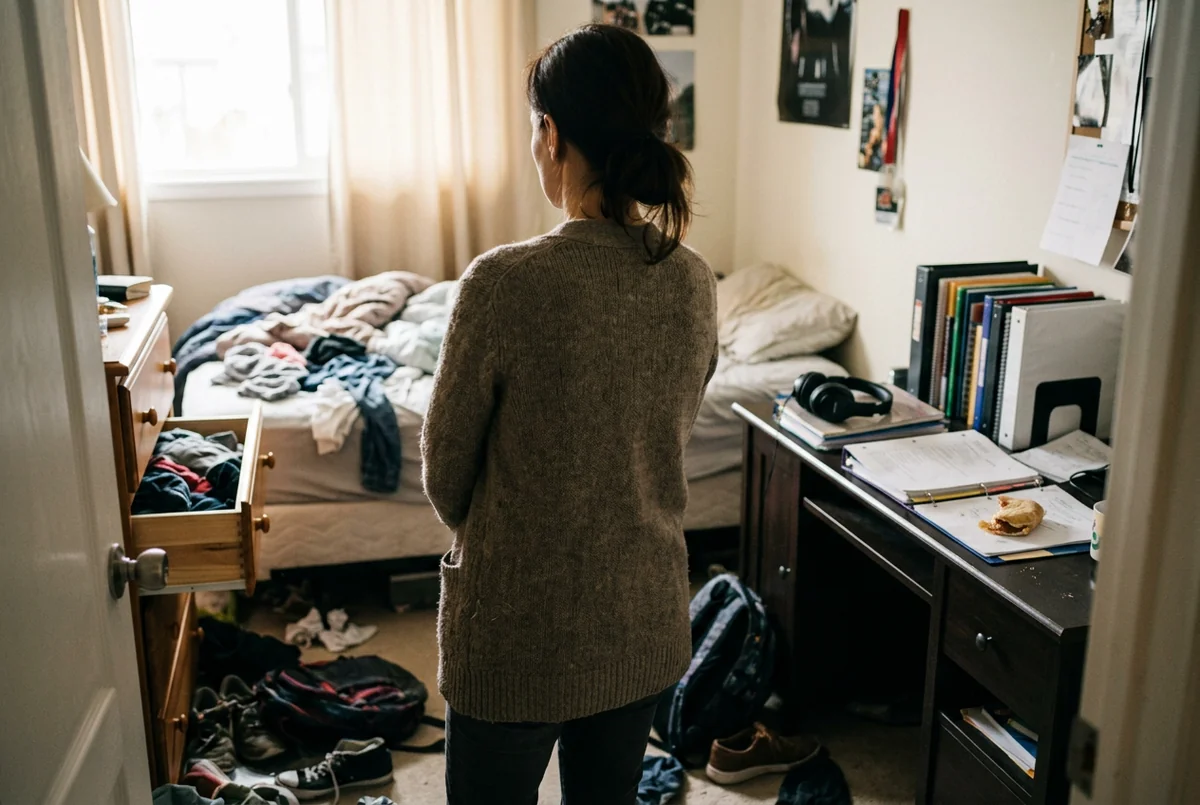
Traces of substances in a teenager's room are easy to find if you know what to look for - the child usually does not reckon with the parent looking under the bed, into the pockets of old trousers or into the backpack on that particular day. The most common finds are small zip-lock plastic bags with remnants of white, beige or yellowish powder (mephedrone, amphetamine, MDMA), rolled-up banknotes or pieces of plastic tubes with powder stains, fragments of mirrors or smooth surfaces with traces of a white line. With cannabis you will find bongs, water pipes, grinders (characteristic metal containers with teeth inside), rolling papers, disposable vapes with an unusual smell or a sealed-up filling port. With prescription medicines - blister packs without labelling, tablets in capsules from packaging not registered in Polish pharmacies, ampoules without labels. Incense sticks and scented candles burned daily, although there was no such habit before, are an attempt at masking. It is worth checking the child's phone openly, not secretly - a parent has significant rights of supervision over a minor, but secretly rummaging destroys trust for many months. If in Telegram, Signal or Threema you see contacts with anonymous nicknames and disappearing messages turned on by default, that is a strong signal. Do not confiscate everything at once - keep one find as concrete evidence for the conversation and secure the rest for later.
What to do when you suspect your child is using drugs
First make sure the suspicions do not stem from a single observation. Go back to the four categories - physical signs, behavioural changes, finds in the surroundings, money disappearing - and check how many of them are piling up over several weeks. If at least three, it is time for a conversation.
The conversation does not take place during intoxication (the child will not remember it and will feel betrayed when the topic comes back while sober), in the presence of siblings, or with shouting. Start with the specifics, with three observations described without judgement. Instead of "I know you're using" say: "for three weeks you've been coming home different from how you left, your pupils are strangely enlarged in the evenings, on Wednesday I found a piece of clothing in the wash smelling of smoke that I don't recognise". The child will usually defend themselves and that is normal. The parent's task in this first conversation is not to force a confession, but to open the topic and signal that help, not punishment, awaits a confession.
After the conversation with the child it is worth calling for support for yourself. A child and adolescent psychiatrist under the NFZ sees patients without a referral, but the waiting time can run to many months - a first private appointment (PLN 200-500 depending on the city) is worth considering as a faster assessment. After the first consultation you usually already have a concrete plan: who to call, what kind of therapy to look for. An addiction treatment clinic (NFZ, no referral) provides individual and group psychotherapy for teenagers; you can also use drug addiction treatment at a private centre if public queues make it impossible to start therapy quickly. A urine test for 5-10 substances can be bought at a pharmacy for PLN 25-50, but using it without the child's knowledge breaks trust - it is better to propose it as part of a joint decision.
Frequently asked questions from parents
How can I tell if my child is using cannabis?
Cannabis leaves three easily noticeable traces: a characteristic sweet, grassy smell (it lingers on the hair, the jacket, in the room for several hours), red whites of the eyes with clearly visible dilated blood vessels, and a marked increase in appetite for sweets and snacks in the evening. The pupil itself usually stays a normal size. Among today's teenagers, the source of THC is increasingly not dried herb but disposable vapes with THC oil bought on the black market - it is worth checking the devices themselves and their smell, because they look innocent and do not smell of typical cannabis.
Can I drug test my child without their knowledge?
A urine test bought at a pharmacy for PLN 25-50 will detect the presence of the most common substances (cannabis, amphetamine, cocaine, opiates, MDMA) over a period from dozens of hours to several weeks, depending on the substance. A parent has significant rights of supervision over a minor, but from the standpoint of addiction psychotherapy, tests carried out secretly almost always do harm - the child discovers the fact, loses trust in the parent for months and closes off even more. Specialists recommend doing the test together, with the child's participation, as part of a therapeutic contract.
What should I do if I find drugs in my child's room?
Finding drugs in a child's room requires three things: staying calm, securing the find without immediate confrontation, and a brief assessment of the situation before you talk. Take a photo, pack one small piece of evidence into a plastic bag, hide the rest. Hold the conversation with the child in private, while sober, with specifics instead of name-calling. The first conversation after a find does not have to lead to a diagnosis or therapy - its purpose is to open the topic without breaking trust.
How long are the signs of intoxication visible?
How long the signs of intoxication remain visible depends on the substance and the way it is taken. Smoked cannabis gives visible signs (red eyes, dry mouth, slowed reactions) for 2-4 hours, cannabis in the form of vaporised THC oils for up to 6 hours. Amphetamine maintains agitation and dilated pupils for 4-12 hours, mephedrone much shorter (2-4 hours - which is why users take it in runs, dose after dose). The residual effect (irritability, insomnia) after both substances can remain visible for another 24-48 hours. Opiates act for 4-8 hours. In blood and urine the presence of a substance can be detected much longer, in the case of THC even up to a month with regular smoking, but the external signs subside earlier.
Do you suspect that your child is using drugs?
Nasz Gabinet specialists help parents organise their observations, plan the conversation with their teenager and choose the right form of therapy. The first consultation lifts you out of uncertainty and gives you a concrete action plan.