

The anti-alcohol injection in Słupsk: naltrexone depot, not the implant
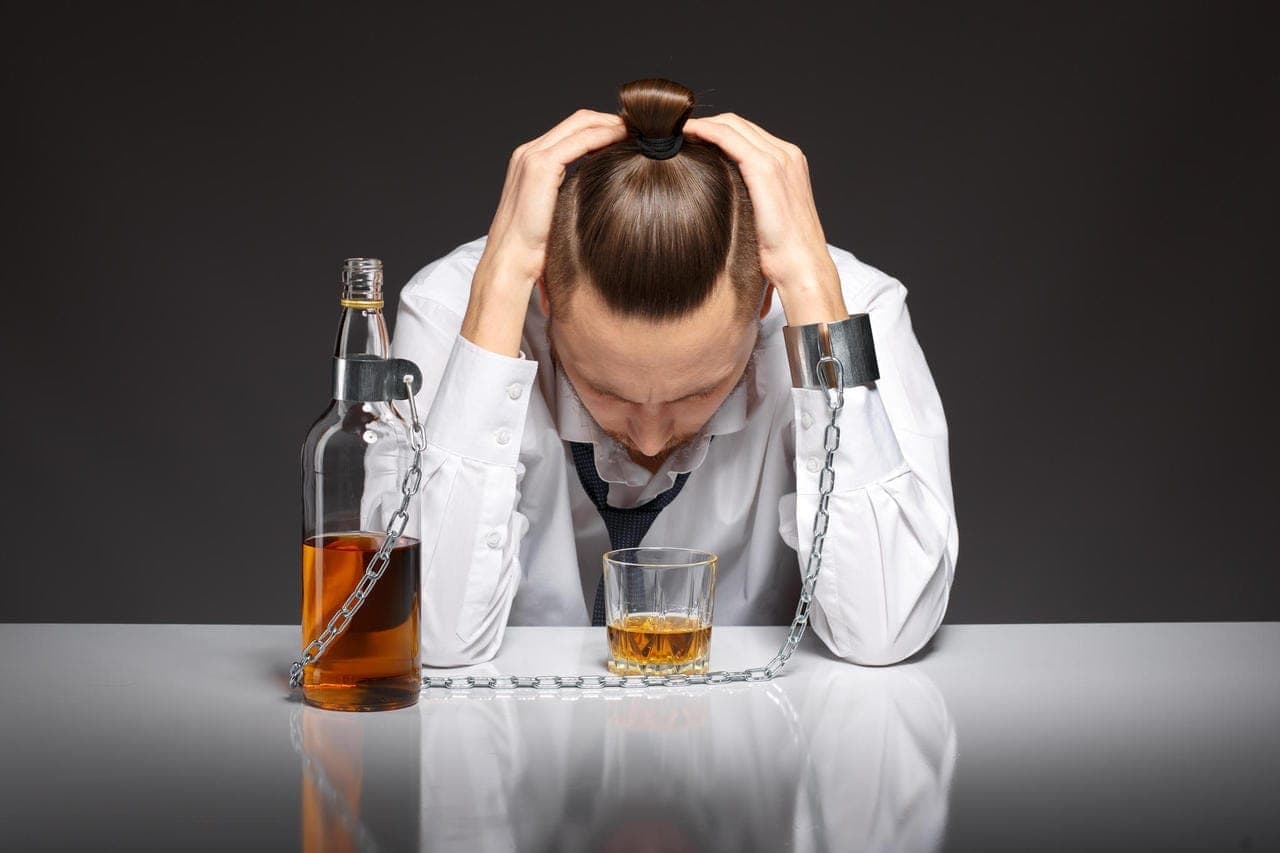
Online, the phrase anti-alcohol injection hides two different drugs, and they are easy to confuse, because both are sometimes given by needle. So before you book a visit in Słupsk, it is worth knowing which of them we reach for. At our clinic the injection means extended-release naltrexone, sold as Vivitrol, and not disulfiram, which stands behind the implant.
Naltrexone versus disulfiram: what separates the two injections
The difference does not lie in the needle, but in what the drug does after drinking. Disulfiram works through deterrence: it couples alcohol with a violent, poorly tolerated episode, so the patient avoids the glass out of fear of the reaction. Naltrexone belongs to a completely different group, the opioid receptor blockers, and sets no trap in the body. After alcohol nothing dramatic happens, because its role is quieter: it takes part of the reward away from drinking, so that day to day the patient does not feel the drug's presence at all.
Why the urge to drink weakens after naltrexone
The urge to drink is born in the reward system, and that rests on the opioid receptors. Naltrexone covers these receptors, so alcohol no longer releases the old rush of pleasure, and each further glass gives markedly less. With time the alcohol craving itself also melts away, that intrusive thought about drinking which is harder to bear than the occasion to drink itself. The drug is not addictive and leaves no symptoms after it is stopped, because it does not stimulate the nervous system, it only quiets it.
Where the injection's monthly reach of a single dose comes from
The monthly rhythm comes from the very build of the preparation. The naltrexone is enclosed in microspheres, tiny beads of a soluble polymer, which after injection release the substance slowly, over the following weeks. This does away with swallowing a daily tablet and watching at home whether today's dose has been taken. A single administration covers a full 4 weeks at once, and the resolve not to drink does not have to be made anew every morning.
The first step in Słupsk: medical assessment for the injection
The whole path begins not with the needle, but with a conversation with the doctor. For the injection this assessment weighs more than for a tablet, because giving naltrexone is decided not by the patient's wish or the family's pressure, but by the doctor's assessment. Without it we do not perform the procedure in Słupsk, and rightly so, because it is assessment that catches the obstacles before the drug reaches the body.
From the phone call to the assessment visit in Słupsk
The starting point is a single phone call, and it can be made just as easily by the patient as by someone from the household. You can come to the visit alone or with a companion, to our clinic on Marszałka Józefa Piłsudskiego 2. The order is different, however, when someone turns up during an active drinking binge or with withdrawal symptoms. Then alcohol detox in Słupsk comes first, and we sit down to the assessment only on a clean body. Naltrexone must not be given to someone who is in the middle of stopping alcohol.
Opioids and illnesses: what the doctor asks about at assessment
During the interview the doctor goes through the drinking history, earlier treatment attempts, chronic illnesses and every medicine being taken. Mood is asked about separately, because its dips more often accompany people who drink. Most attention, however, goes to opioids. Naltrexone and opioid drugs cancel each other's action, so the doctor must know every such preparation around the patient, from strong painkillers to substitution treatment. Concealing them is dangerous, not merely an obstacle to setting the date.
The panel of tests that precedes the first dose of the injection
Assessment is not only the interview. Alongside it goes a full set of tests, meant to confirm on paper what the doctor heard in the conversation: that naltrexone will harm no one. We set the date of the injection in Słupsk only with the results in hand.
What the panel of tests before naltrexone includes
On the list are a complete blood count, a liver panel and tests for hepatitis B, hepatitis C and HIV, and for women of childbearing age additionally a pregnancy test. This is not gathering papers just in case. Each item answers a different question about safety, and only the whole set together lets the doctor give the drug with peace of mind.
Why the liver matters most with the injection
Of all the results we read most carefully those concerning the liver, because it is the liver that breaks naltrexone down. Severe liver diseases close the door to the injection, which is why the liver panel is not a formality but a real gate. For women of childbearing age the pregnancy test plays a similar role: pregnancy rules out the injection, so we settle this beforehand, not on the day of the visit. The whole panel is collected quickly, and it gives the certainty that nothing important has slipped through.
Targeted import: the legal route of Vivitrol to Słupsk
When the results are good, the longest stretch of the whole road begins, namely bringing the drug in. With it returns a question we hear at almost every first conversation: whether the anti-alcohol injection is legal in Poland at all. It is worth settling straight away.
Why bringing Vivitrol in is compliant with the law
Let us start from the fact that Vivitrol indeed does not appear in the Polish drug register. That, however, is not the same as a ban: for drugs without national registration the law keeps a separate path, targeted import (import docelowy). It allows the preparation to be brought in by name, for a specific patient, just like other drugs unavailable here. The order of steps is strict: the doctor files an electronic request in the SOID system, a voivodeship or national consultant reviews it, usually within 7 days, and the Minister of Health signs the approval. The foundation of the whole thing is a diagnosed alcohol dependence, so the black market does not come into play at all; the waiting time does.
How the drug reaches Słupsk and why it needs cold storage
The minister's signature is not yet the end of the road. The physical order is placed by a pharmacy, and a wholesaler arranges the transport, so the drug does not appear overnight. A targeted-import prescription stays valid for 120 days, which is why we reserve the successive doses with time to spare, so that no gap opens up in the once-every-4 weeks rhythm. A separate problem is the preparation's sensitivity to heat: it is kept in cold storage, at 2 to 8 degrees Celsius, and warmed only just before the injection. This cold chain is one of the reasons we perform the injection at the Słupsk clinic, not in the patient's home.
Reimbursement and what the cost is made of
What remains is the question of money. A reimbursement application goes to the Minister of Health and is considered case by case, but for Vivitrol in the treatment of alcoholism no approval has so far been granted, and in 2022 the AOTMiT Transparency Council judged such reimbursement unjustified. In practice this means the patient pays for the drug, and we say so openly before the bringing-in starts. The cost, moreover, is not a single figure but the sum of several items, which we write down after assessment, when setting the date.
How the 380 mg injection proceeds and the monthly rhythm of the dose
The day of the injection turns out calmer than the imagination suggests, because the whole thing comes down to a single shot. Patients usually ask about the same things: what the injection looks like, how often the dose returns and when the treatment can be brought to a close.
How the injection is given at the clinic
Before the drug enters the muscle, the doctor makes one more short review. He makes sure that no opioids have come in since the previous visit, that there is no jaundice or withdrawal symptoms and that there is no operation with opioid anaesthesia in the plans. In parallel, the preparation taken out of cold storage reaches room temperature. Only then do 380 mg travel deep into the gluteal muscle, and at each following visit the side changes. The patient brings nothing and has to prepare nothing at home.
Why the dose returns once every 4 weeks
A single administration works for roughly 4 weeks, so the next injection falls once a month. Towards the end of this window the drug begins to weaken, which is a further reason not to push the visit back. If the date is nonetheless delayed, we give the next administration as soon as possible, but no sooner than after 4 weeks and in no dose larger than 380 mg. For a resident of Słupsk this is one short visit a month, easy to fit into the calendar.
How long naltrexone treatment lasts and what the studies say
The length of the whole treatment does not fit into a single number. The manufacturer's product information sets no rigid end, scientific societies usually speak of at least six months, and in practice it is decided by maintained abstinence and the response to the successive doses. I give the figures from studies as a point of reference, not a promise of effectiveness. Garbutt's team published a result in the journal JAMA in 2005 in which, at the 380 mg dose, days of heavy drinking were roughly a quarter fewer than after placebo. A newer pooled analysis from 2022, made up of seven studies, pointed to greater benefit with treatment longer than three months, with the caveat that the observations reached at most half a year. Naltrexone on its own, moreover, gives less than when it goes hand in hand with therapy.
The limits of naltrexone: opioids, the liver and pregnancy
Naltrexone has a long history and solid documentation behind it, but it is not a drug without limits. Those limits must be stated at assessment, before the first administration, and not after the fact. That is why the patient hears the full list of risks from the doctor plainly.
Loss of opioid tolerance: the most serious risk
On this point we dwell the longest, because life can be at stake. For weeks naltrexone keeps the opioid receptors occupied, so the body grows unaccustomed to opioids and, after treatment ends, reacts to them far more strongly than before. This heightened sensitivity does not disappear overnight, it drags on for some time after the last dose. It becomes most dangerous when someone wants to break through the blockade with a larger portion of an opioid or goes back to the doses from before treatment, because this risks respiratory arrest, sometimes fatal. Hence the rule without exceptions: for at least 30 days from the last injection no opioids at all, and it is worth carrying information about the naltrexone on you in case of injury or sudden surgery.
Naltrexone side effects in everyday life
Most adverse effects are mild and transient: nausea, headache, drowsiness, muscle and joint aches. At the injection site there may be tenderness, hardening or swelling, and quite exceptionally a skin change that is better shown to a surgeon. Two matters we keep under stricter control. The first is the liver, whose jaundice, dark urine or abdominal pain are a signal for urgent contact. The second is mood, more often lowered in people with an alcohol problem, so we do not leave it without a question.
When the injection cannot be given
Beyond that there is a short list of states in which the injection is ruled out from the start. We will not give naltrexone to anyone who:
- reaches for any opioid drugs, from substitution therapy to strong painkillers,
- is right in the middle of a withdrawal syndrome, that is withdrawal symptoms,
- has acute hepatitis or severe liver failure,
- is pregnant,
- does not tolerate naltrexone itself.
A separate, borderline situation is a planned operation in which it is hard to manage without an opioid painkiller. This is exactly why we run the assessment and tests with such care, so that all these obstacles come to light before the needle even comes into play.
Słupsk: emergency intervention versus planned addiction treatment
The naltrexone injection does not work in a vacuum, it plugs into how access to help looks in a given city. Here Słupsk shows a clear split: the emergency response to the effects of drinking exists, but the planned treatment of alcohol craving that the injection targets is distinctly scarcer in the city.
Emergency help for intoxicated people in Słupsk and the region
The emergency side is clearly visible in Słupsk. The municipal centre for intoxicated persons takes in about 2 thousand people a year, and not only from Słupsk, because under agreements it also serves nine surrounding municipalities. After the facility was handed over to a non-governmental organisation, the number of places was cut from 22 to 10, so this emergency base is shrinking rather than growing. The thing is that sobering up under supervision can be a rescue for a single night, but it moves neither the alcohol craving nor the reward system. On its own it treats nothing.
Alcohol more easily available than planned therapy
On the other side is the availability of alcohol itself. The number of its sale points in Słupsk did fall from 285 in 2021 to 266 at the end of 2024, but that is still 176 shops and 90 catering venues in a city of not quite a hundred thousand. Planned addiction treatment, meanwhile, rests here on a narrow base: a single alcohol addiction therapy clinic and a day ward, which serve the whole city together with the county. When someone finally decides to quit drinking, this imbalance, alcohol within arm's reach and a queue for therapy, can smother a fresh resolve.
Where the injection fits into all this
The naltrexone injection steps precisely into that gap, between emergency sobering up and long-awaited planned treatment. It is a planned method, led by a doctor, which in Słupsk can be booked without waiting in a queue and without a referral, and the administration returns only once every 4 weeks. It does not replace therapy and does not pretend to solve everything on its own, but it shortens that first, most fragile interval in which it is easiest to give up.
Injection, implant or tablets and how to book a visit in Słupsk
Since the alcohol implant and tablets already exist, why would anyone still need the injection? This question comes up in most first conversations in Słupsk. The three methods really do differ, and not in the way they are delivered, but in what each of them does with drinking.
Three roads against one addiction
The simplest way is to line up these three methods by how each deals with drinking. Naltrexone in the injection forbids nothing and threatens with nothing: after alcohol there is no unpleasant reaction, the drug simply takes the reward away from drinking and, from week to week, extinguishes the craving. Disulfiram in the implant works exactly the other way, because it builds a barrier out of fear of a violent reaction after a glass. The tablets are again the same naltrexone, only in a version for daily swallowing on one's own. For anyone more convinced by a clear, deterrent boundary, there is a separate page for the alcohol implant in Słupsk.
When the injection works out better
The most is gained from the injection by those for whom daily self-discipline is the weakest point. The daily tablet falls out of rhythm exactly when things are hardest, and those moments most often end in relapse. The once-a-month injection removes that daily test of will, because the decision was already made at the administration. The implant, in turn, suits someone who wants a clear barrier right away, because the injection has its weaker point in the calendar: Vivitrol first has to be brought in through targeted import, and that means a few weeks of delay, which the implant does not require.
Booking a visit in Słupsk and the role of loved ones
It starts with a phone call to 880 808 880, and we carry out the assessment and the injection at our clinic on Marszałka Józefa Piłsudskiego 2, without a referral. Since the drug alone rarely closes the matter, from the first visit we combine it with addiction therapy in Słupsk, and in harder cases with full alcoholism treatment in Słupsk. Loved ones will not go through assessment for the patient, but they can do what is hardest: the first phone call, coming to the visit together, keeping an eye on the following dates. We advise against only one thing, bringing someone against their will, because naltrexone works best when the patient wants to try on their own.