

What the anti-alcohol injection is and what it is not
The anti-alcohol injection sounds like a single solution, yet online this one phrase covers two different medicines. Before we set it against the implant and tablets, it is worth establishing what we are even talking about. At our Bydgoszcz clinic the injection means extended-release naltrexone, sold under the name Vivitrol, and not the disulfiram behind the implant.
Why the injection gets confused with the implant
The difference begins with the class of medicine. Disulfiram, the heart of the implant, is an aversive agent: it ties alcohol to a violent, unpleasant episode, so that drinking comes to mean feeling ill and keeps the patient away from the glass. Naltrexone belongs to the opioid receptor antagonists, an altogether different shelf. It sets no trap for alcohol in the body, so after drinking nothing violent happens. It works more quietly, subtracting part of the pleasure from drinking, so that the patient usually does not feel it working at all.
What naltrexone does to the urge for alcohol
Behind the urge to drink stands the reward system, built on opioid receptors. When naltrexone blocks them, alcohol stops setting off its old rush of pleasure, so the next glass gives less and less. From week to week the nagging thought of drinking weakens too, and it is that thought, not the glass itself, that is often the hardest to bear. The medicine is not addictive and, once treatment ends, leaves no withdrawal symptoms, because it does not stimulate the nervous system, it only damps it down.
Where a single dose's month-long action comes from
The month-long reach comes down to the medicine's technology. The substance is enclosed in microspheres, tiny beads of dissolvable polymer that, once injected into the muscle, release the naltrexone gradually over the following weeks. This does away with the daily tablet ritual, and with it the household arguments over whether it has been taken today. One procedure covers a full 4 weeks at once and does not make the patient decide anew every morning.
Injection, implant or tablets: which method to choose
If both the implant and tablets exist, why would anyone still need the injection? This question comes up in most first conversations. The three methods really do differ, and the difference does not come down to the form of delivery, but to what each of them does to drinking.
Three different ideas for one problem: implant, injection, tablets
The disulfiram implant is a method of the barrier: after alcohol comes a reaction dangerous enough that the patient does not drink, because they would rather avoid it. The naltrexone injection comes at it from the other side, without aversion. After alcohol it triggers no unpleasant symptoms, it only takes the reward away from drinking and gradually quiets the craving. Tablets contain the same naltrexone, but in a version to be swallowed on one's own, every day. For anyone drawn more to a hard limit after drinking, we describe it separately on the page about the alcohol implant in Bydgoszcz.
When the injection comes out better than the implant or tablets
The injection shows its advantage where daily discipline fails. A tablet is easiest to skip in exactly the weaker moment, and those weaker moments often decide a return to drinking. A monthly dose removes this daily test of willpower. The implant, in turn, suits someone better who wants a clear, deterring limit after every glass, one that naltrexone itself does not set.
Why the doctor chooses the method at the assessment
There is no method best for everyone, there is a method best for the particular person. What decides it is the drinking history, coexisting illnesses, the medicines being taken and what the patient fears most. That is why the choice is made at the assessment, together with the doctor, and not at the kitchen table or after reading a forum. The family gains from this most, because no one has to take a medical decision solely on themselves.
Medical assessment before the injection in Bydgoszcz
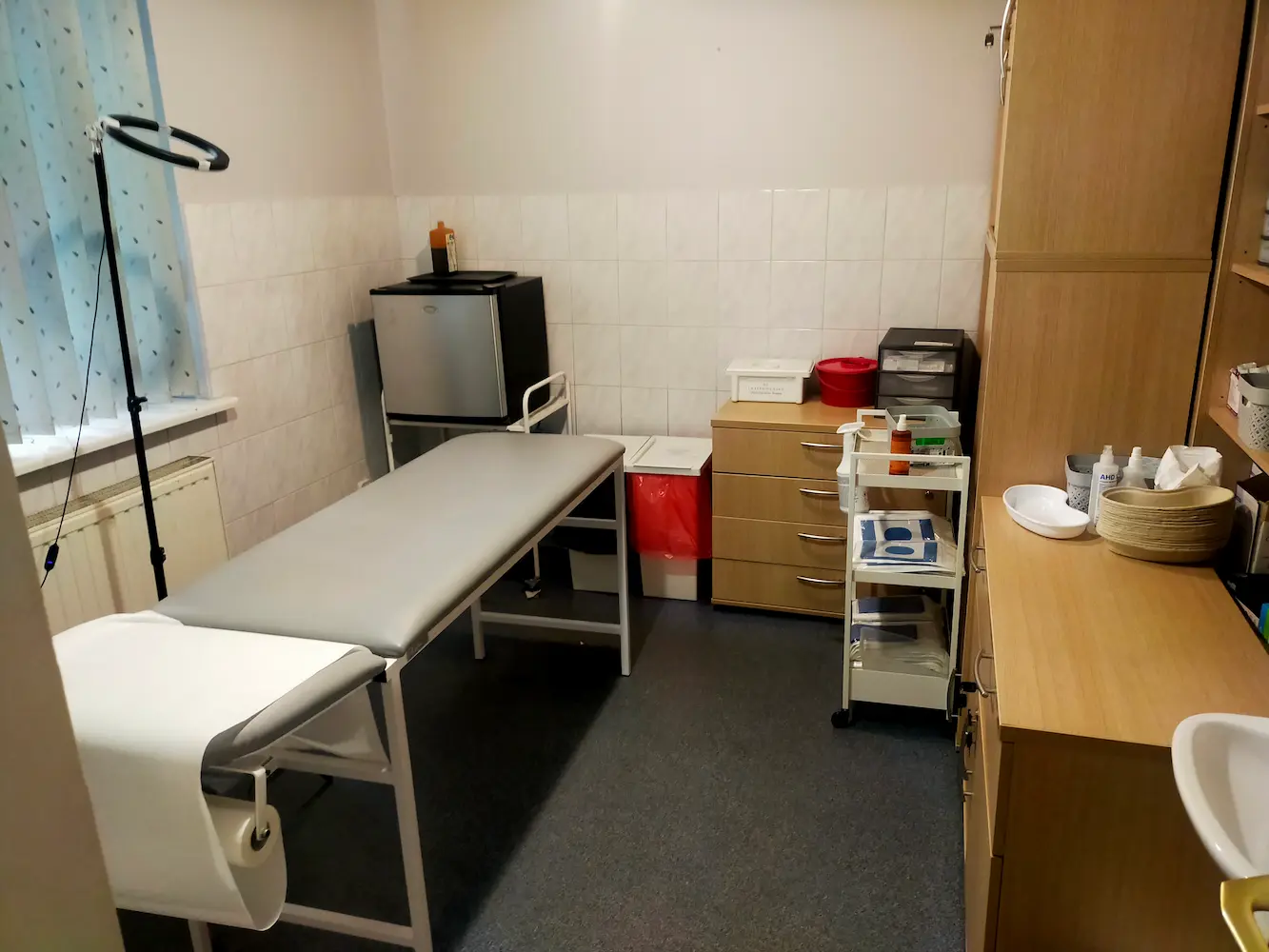
Whichever method the doctor points to, the starting point is the same: the assessment. With the injection it carries extra weight, because giving naltrexone is decided neither by the patient's wish nor by pressure from the family, but by the doctor's assessment. Without it we do not perform the procedure.
The first call and the first visit in Bydgoszcz
Booking the assessment is one phone call to our Bydgoszcz clinic, made sometimes by the patient, sometimes by a member of the household. You can come to the visit alone or with someone accompanying you. If the patient turns up during a binge or with withdrawal symptoms, the order reverses: first alcohol detox in Bydgoszcz, and we carry out the assessment once the body is clear. Naltrexone must not be given to someone who is in the middle of coming off alcohol.
The assessment interview: what matters most
The doctor asks about the course of the drinking, earlier attempts at treatment, chronic illnesses and the full set of medicines being taken. Mood comes up separately, because dips in it appear more often in people who drink. The greatest attention, though, goes to opioids. Naltrexone and opioid medicines act against each other, so the doctor has to know every such preparation around the patient, from strong painkillers to substitution treatment.
Naltrexone: safety, side effects, contraindications
Naltrexone has a well-established position and is solidly researched, but it also has clear limits, and at the assessment these have to be said out loud. The patient learns the full list of risks from the doctor before the first dose, never after the fact.
Loss of opioid tolerance, a risk to life
This is the one warning we discuss at such length, because life is at stake. During treatment the body loses its habit of opioids and becomes far more sensitive to them, and this change lasts for some time after the last injection. Anyone who tried during this period to break through the block with a larger dose, or went back to the amounts from before treatment, risks respiratory arrest, which can end in death. The rule is absolute: for at least 30 days from the last dose, no opioid medicines at all. It is also worth carrying information about taking naltrexone, in case of sudden injury or urgent surgery.
The side effects of naltrexone you can expect
Most adverse effects are mild and pass quickly: nausea, headache, drowsiness, muscle and joint aches. The injection itself can leave tenderness, a lump or swelling at the injection site, and quite rarely a change that a surgeon should look at. Two areas we keep under closer watch: the liver, where jaundice, dark urine or abdominal pain is a signal to get in touch urgently, and mood, which in people who drink can be low.
Situations that rule the injection out entirely
There are also conditions in which the way to the injection is closed from the outset. We will not give naltrexone to a person who:
- takes opioids in any form, from painkiller prescriptions to substitution treatment,
- has acute hepatitis or severe liver failure,
- is currently going through a withdrawal syndrome, that is, withdrawal symptoms,
- is pregnant,
- does not tolerate naltrexone itself.
A planned procedure that will involve opioid painkillers calls for separate caution. This list is why the assessment acts for us as a real safety filter, not a formality ticked off before the dose.
What the dose looks like and how long treatment lasts
The day of the injection turns out less dramatic than the imagination suggests, because it is one shot and that is all. Patients usually ask about three things: what the dose itself is like, how often it comes back and when treatment can be brought to a close.
How the injection is given at the clinic
Before the injection is given, the doctor goes through a short checklist once more: whether any opioids have appeared, whether there is no jaundice or withdrawal symptoms, and whether the patient has no procedure ahead that would use opioid painkillers. In the meantime the medicine reaches room temperature. Then 380 mg goes deep into the gluteal muscle, on the opposite side at each subsequent visit. It takes a moment and calls for no preparation at home.
How often the injection dose comes back
A single dose keeps working for roughly 4 weeks, so the following injections fall once a month. Towards the end of this window the medicine begins to weaken, which is a further argument not to put the date off. If a dose slips, we give the next one as soon as possible, but no earlier than after 4 weeks and no more than 380 mg at a time. Such a monthly rhythm fits into a calendar without trouble.
Length of treatment and what the studies show
How long the whole treatment will last cannot be pinned to one number. The manufacturer's information sets no rigid framework, and scientific societies usually speak of at least half a year. In practice what decides is whether the patient keeps abstinence and how they respond to the successive doses. I give the study results as a reference point, not as a promise. In Garbutt's 2005 paper, published in the journal JAMA, the 380 mg dose was linked with a number of heavy-drinking days lower by roughly 25 percent than with placebo. A more recent pooled analysis of seven studies from 2022 suggested a greater benefit with treatment longer than three months, though the authors noted that the data reach six months at most. In any case, naltrexone reaches its full potential only paired with therapy.
The anti-alcohol injection in Bydgoszcz against the city's map of help
The naltrexone injection does not work in isolation from how the city copes with alcohol. Bydgoszcz is an interesting example here, because the public response focuses mainly on emergencies and less on the planned treatment of alcohol craving that the injection aims at.
Why Bydgoszcz has no sobering-up station
Bydgoszcz is one of the larger cities without a sobering-up station of its own. The one on Przemysłowa Street operated until the end of March 2010, and the councillors took the decision to close it in December 2009. As a result, intoxicated residents who need help now end up in the city hospitals, around two thousand people a year, and they wait several hours in a hospital emergency department until they sober up. Hence the recurring call to recreate the sobering-up station and a detox ward. This ad hoc route treats nothing, because it deals with the aftermath of a single night, not with the addiction.
What the night-time alcohol sales ban in Bydgoszcz changes
The city's second step is to limit access. By a resolution of 29 October 2025 the City Council introduced a night-time ban on the off-sale of alcohol, from 23:00 to 6:00, across the whole of Bydgoszcz, in shops and at petrol stations. The ban takes effect on 1 February 2026, and catering venues are exempt from it. Earlier, a similar restriction in the Old Town Cultural Park clearly reduced the number of reported incidents. These are sensible measures, but they too concern the availability of alcohol, not the urge to drink itself.
Where the naltrexone injection fits on this map
It is exactly this gap that a planned, doctor-led path fills. The anti-alcohol injection starts with a medical assessment, and it aims at what the hospital shift and the sales hours leave untouched, namely the alcohol craving and the reward system. It is not a separate path alongside therapy, but one of its tools. It works for someone who has had enough of the daily fight with the thought of a drink and is looking for a solution with a clear assessment, not another emergency intervention.
Where in Bydgoszcz to book the injection and the role of loved ones
The most practical question remains: how, concretely, to get going. The answer is short, because the whole path begins with one phone call, often made by a loved one.
Booking an assessment for the injection in Bydgoszcz
The number is 880 808 880, and we book the assessment at the clinic at Augusta Cieszkowskiego 5. No referral is needed, just as at an addiction treatment outpatient clinic. Because the medicine alone rarely settles the matter for good, from the first visit we tie it to addiction therapy in Bydgoszcz, and in more severe situations to full alcoholism treatment in Bydgoszcz.
The role of loved ones around injection treatment
Loved ones will not give the medicine or go through the assessment for the patient, but they take on the hardest part: they help make the first step. You can call for details, come to the visit together, keep an eye on the dates of the next doses. There is only one thing we advise against, bringing someone in against their will. Naltrexone works best when the patient wants to try of their own accord, and the family's task is to make that decision easier, not to force it.
Why we do not give the price over the phone
We will not give a single figure over the phone, because it is made up of several separate components: the consultation, the medicine itself and the dose with the later visits. Which of them will be needed is clear only after the assessment, so any number thrown out earlier would be fortune-telling. That is why we present the full quote after the first visit, calmly and in writing.