

Alcohol implant in Bydgoszcz: what it is and how disulfiram works
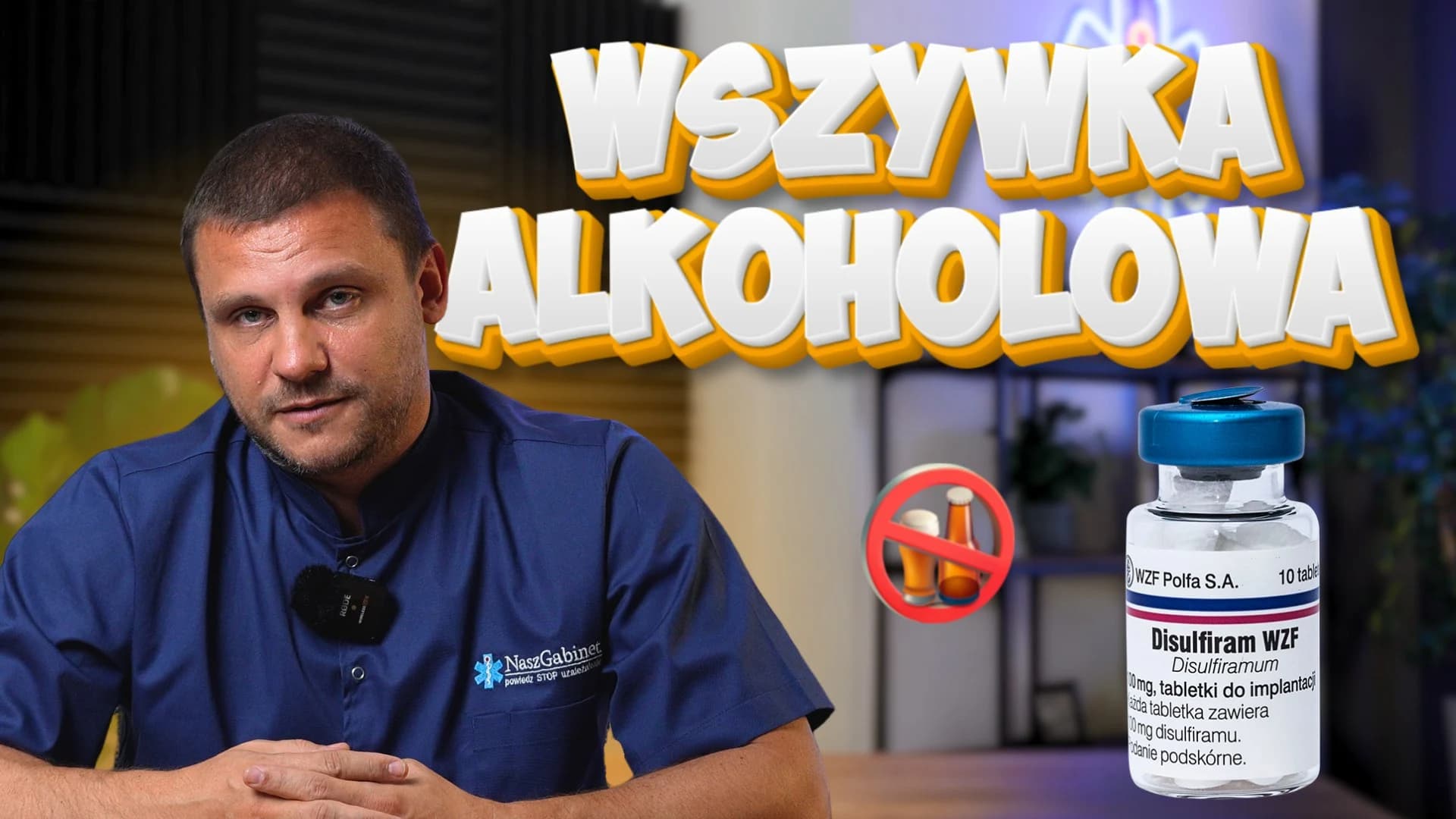
An alcohol implant is the common name for a procedure in which a doctor places sterile disulfiram tablets under the fascia. One preparation is registered for this in Poland: Disulfiram WZF from Polpharma, tablets for implantation containing 100 mg of the active substance, marketing authorisation no. R/1038. Esperal is a trade name that has caught on as the everyday word for the whole procedure, and it is the name patients most often ask about.
Disulfiram inhibits aldehyde dehydrogenase, the enzyme needed at the second stage of alcohol breakdown. Normally the body converts ethanol into acetaldehyde, acetaldehyde into acetic acid, and the acid into water and carbon dioxide. Blocking the enzyme stops the process at acetaldehyde, which is toxic and causes the symptoms of poisoning.
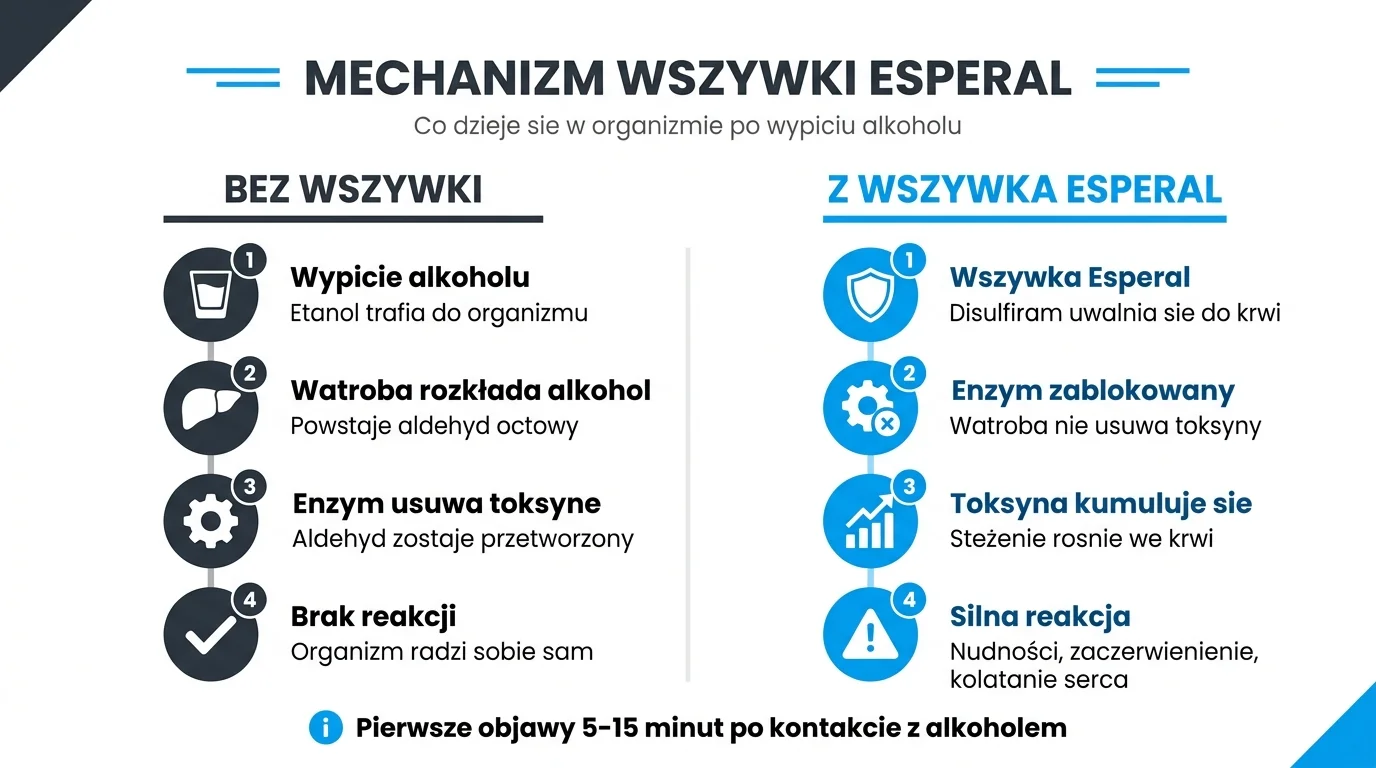
Several things follow from this mechanism that are worth understanding before deciding:
- Without alcohol, disulfiram does nothing. It does not change mood, does not calm anyone down and has no psychoactive effect. Someone who does not drink cannot feel that the implant is there.
- It does not reduce the urge to drink. The craving stays the same; what changes is what happens after drinking. Medicines that lower craving are a separate group and a separate decision for the doctor.
- It does not treat addiction, it gives time for therapy. After eight months the implant stops working and the patient is back where they started, unless therapy began in the meantime.
The manufacturer's information allows the procedure to be repeated after eight months. In practice people speak of 8 to 12 months of action, because the release rate depends on metabolism and body weight.
Patient consent and 24 hours without alcohol: conditions for the procedure in Bydgoszcz
The most common call to the Bydgoszcz clinic goes like this: a wife or a mother rings and asks whether she can book her husband or son for an implant, preferably today, because another binge has just ended. Our answer is always the same, and it is better to know it before coming to Cieszkowskiego.
Consent to an alcohol implant: why the family cannot sign it
Disulfiram must not be given to a person who does not know about it or does not agree to it. This is required by the manufacturer's information about the medicine and by the patient's right to decide about their own treatment. An adult signs the consent in person, after a conversation with the doctor in which they learn what will happen if they drink with the implant. A wife, a husband, parents or adult children cannot sign it for them.
This is about safety, not paperwork. The reaction after alcohol can be life-threatening, and someone who does not know they have an implant has no way of protecting themselves: they will drink, because they have no reason to expect anything bad to happen.
If a relative does not want treatment, a private procedure is not the way and no clinic can get around that. An application for a court order to undergo addiction treatment is filed by the municipal commission for solving alcohol problems or by a prosecutor, not by the family.
How many hours without alcohol before an Esperal implant
Alcohol taken within the last 24 hours is an absolute contraindication to the procedure. The implant works from the moment it is placed, so implanting it in someone who still has ethanol in their blood will trigger the reaction straight away, in the clinic. The manufacturer's information requires a minimum of 12 hours of abstinence; we ask for 24, and after a longer binge for 48, because the margin is then more reliable.
This is where the real problem starts for most patients: to break off drinking for 24 hours you have to get through withdrawal, and after a long binge withdrawal itself can be dangerous. That is why the road to an implant most often leads through alcohol detox in Bydgoszcz, after which we perform the procedure the same day.
Who can have an alcohol implant and who cannot: contraindications
A doctor decides about the procedure after a conversation and an examination. Booking an appointment by phone is not yet an assessment. The interview covers chronic illnesses, medicines taken, drinking history and earlier attempts at treatment. Some contraindications rule the procedure out completely, others call for caution and an individual assessment.
When we will not perform an implant: absolute contraindications
We do not perform an implant when there is:
- hypersensitivity to disulfiram or thiocarbamates,
- a state of intoxication, or alcohol taken within the last 24 hours, including in the form of a medicine or another preparation containing ethanol,
- heart disease: heart failure, coronary artery disease, arterial hypertension, past peripheral circulatory failure,
- psychosis, with the exception of past acute alcoholic psychoses,
- a history of suicide attempts.
The last point surprises people, so it is worth explaining. Disulfiram rarely, but genuinely, causes psychotic reactions and deepens depression. In someone with a suicide attempt in their past that risk is too high to take.
Relative contraindications, pregnancy and breastfeeding
These call for consideration and sometimes for additional tests: respiratory diseases, diabetes, epilepsy, kidney failure, liver failure. Not every one of them closes the door to the procedure, but each changes the balance of risk and the doctor has to know about it before making a decision.
In the first trimester of pregnancy disulfiram is not recommended; in the second and third the decision requires weighing benefit against risk. During breastfeeding the medicine is not used, because there is no data on whether it passes into milk.
Disulfiram interactions with medicines
Interactions matter more here than in most procedures, because some medicines change the strength of the reaction after alcohol in both directions:
- metronidazole - concurrent use is not recommended, it risks states of disorientation and psychotic symptoms,
- amitriptyline and chlorpromazine - intensify the reaction after alcohol,
- diazepam - weakens the symptoms of the reaction, which is dangerous because it creates the illusion that the implant is not working,
- anticoagulants, phenytoin, isoniazid, rifampicin - require caution and monitoring.
Paracetamol and ibuprofen are safe, provided they are not in a form containing alcohol. It is best to bring a list of the medicines you take written down, or to show the packaging, because something almost always slips the memory.
Esperal implantation in Bydgoszcz step by step: from consultation to follow-up
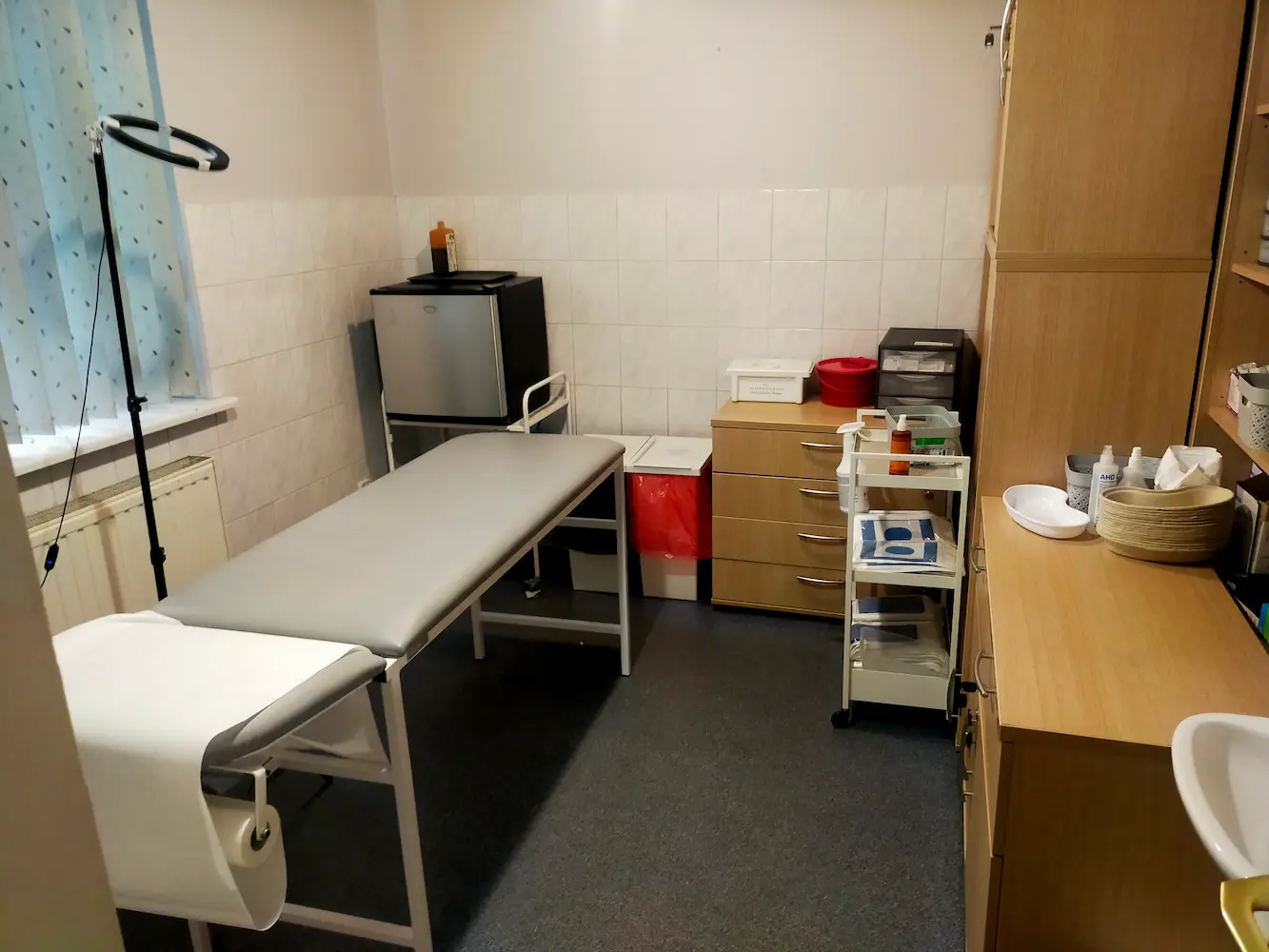
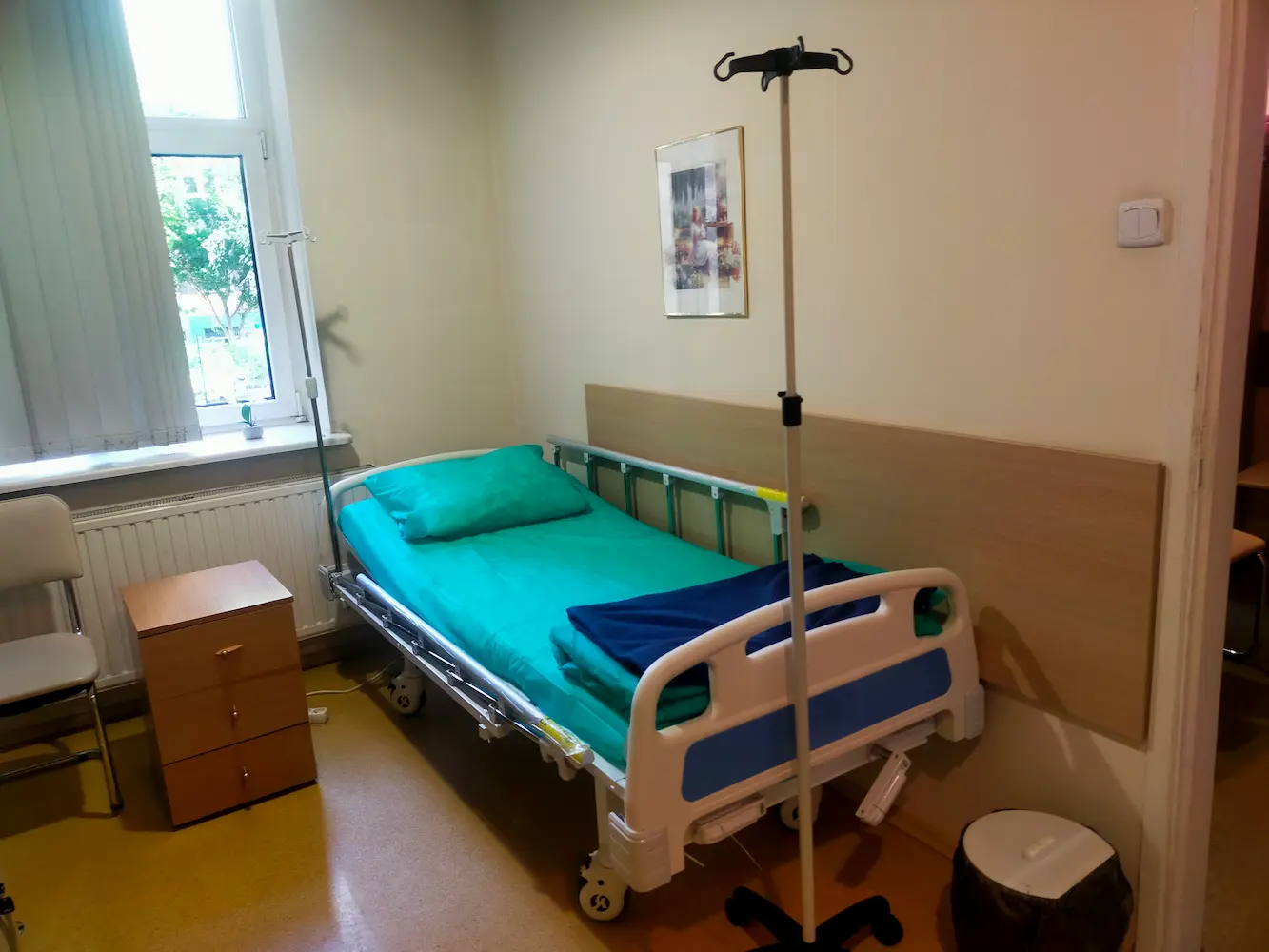
An implant is a surgical procedure, though a small one. We perform it on an outpatient basis, under local anaesthesia, at the clinic at Cieszkowskiego 5. The patient goes home the same day and does not need hospitalisation.
1. Conversation with the doctor and signing the consent
The doctor takes the history, assesses contraindications and explains what will happen after drinking alcohol with the implant. The patient signs the consent only after that conversation. If the doctor considers it necessary, they order additional tests, most often a blood count and liver function tests.
2. Implantation under local anaesthesia
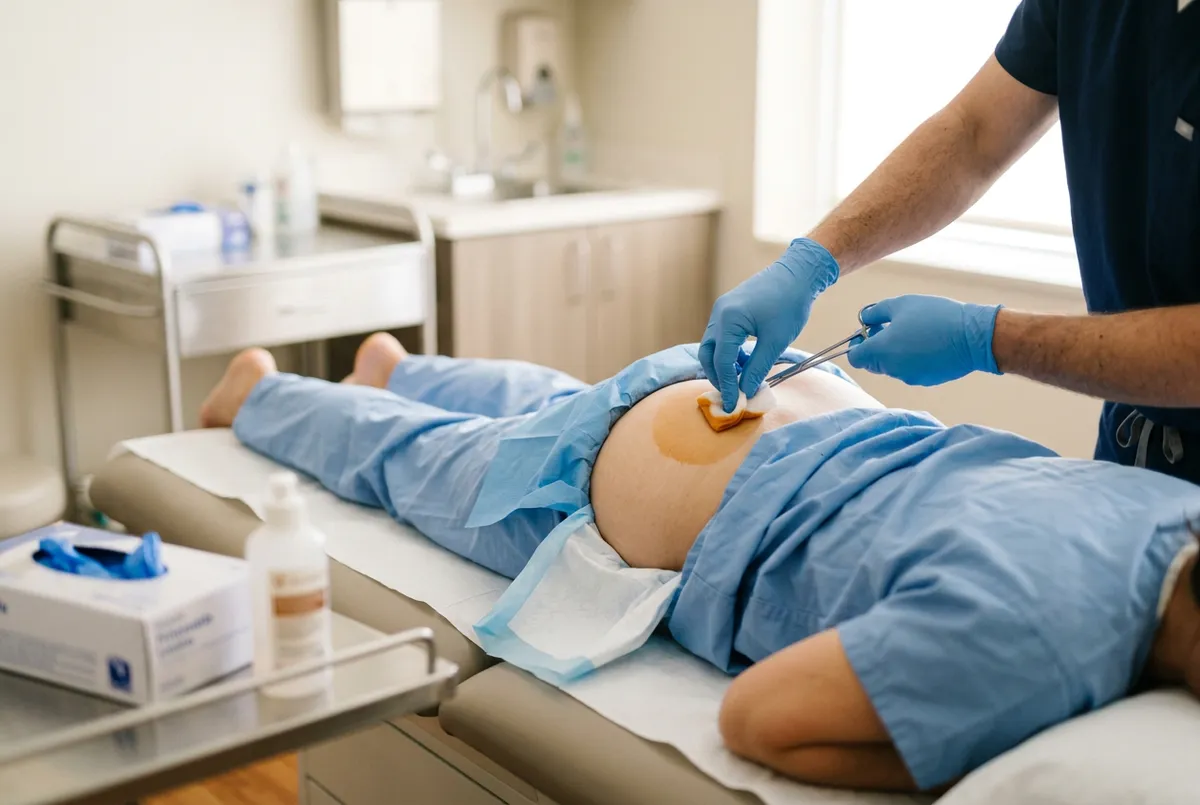
The site, usually the buttock area, is disinfected and anaesthetised locally. The doctor makes a small incision and places the sterile disulfiram tablets under the fascia, that is deeper than just beneath the skin. The wound is sutured and covered with a sterile dressing. The whole thing takes 20 to 30 minutes.
Local anaesthesia removes the pain of the procedure itself. What you do feel is the needle with the anaesthetic going in and the pressure while the doctor works.
3. Free follow-up visit after the procedure
The wound heals in 7 to 14 days and at the end of that period we invite you for a follow-up, included in the price of every package. The doctor assesses the healing and, with non-absorbable sutures, removes them. In the VIP package the sutures are absorbable, so the follow-up serves only to assess the wound and to talk about further treatment.
Local anaesthesia is the reason we ask you not to drive straight after the procedure. Disulfiram itself, according to the manufacturer's information, probably does not affect the ability to drive.
Recommendations after Esperal implantation: wound healing and what to avoid
Wound care after an implant
Healing takes 7 to 14 days and during that time the wound needs ordinary, attentive care, the same as after any minor surgical procedure.
- For the first 2 to 3 days do not get the wound wet; protect the dressing when bathing.
- Do not touch the wound with unwashed hands and change the dressing for a sterile one as the doctor instructed.
- For a week give up physical exertion and do not press on the site, including by sitting directly on the wound.
- Do not remove the sutures yourself.
- Wear looser clothing; tight clothes rub and irritate the area around the wound.
Call the clinic if redness around the wound is spreading, if swelling appears, if there is purulent discharge, a fever above 38 degrees or pain that ordinary painkillers do not relieve. These are signs of infection and need to be assessed sooner than at the scheduled follow-up.
Products with alcohol that have to be avoided
The reaction is triggered by ethanol, wherever it comes from. So besides alcoholic drinks you have to watch out for:
- cough syrups and other alcohol-based medicines,
- mouthwashes, aftershaves and cosmetics containing alcohol,
- vinegar and sauces with wine or another alcohol added,
- warming rubs applied to the skin,
- organic solvents, including ones inhaled at work.
It is worth reading the ingredients, because alcohol hides under the names ethanol, alcohol denat. and spiritus. We advise against non-alcoholic beer for a different reason than its trace ethanol content. For most people it is a trigger: the taste and the situation bring back the reflex to drink. The implant protects against the consequences of a relapse; on the relapse itself it has no effect.
The disulfiram reaction: what happens after alcohol with an implant
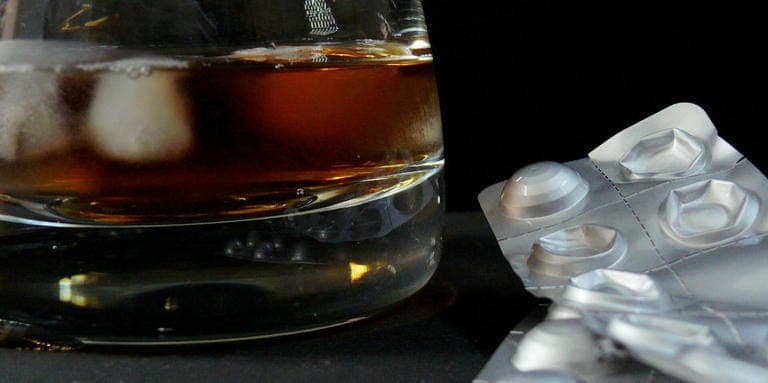
The symptoms are predictable in kind and unpredictable in strength. Nausea and vomiting appear, a fast heartbeat, a drop in blood pressure, dizziness, sudden flushing of the face with a feeling of heat and a metallic taste in the mouth.
The reaction usually lasts 30 to 60 minutes, sometimes several hours. Strong drowsiness follows, and the sleep can last more than a dozen hours.
With larger amounts of alcohol the picture turns serious: heart rhythm disturbances, respiratory and circulatory failure, loss of consciousness and convulsions. Deaths have been described in people who were not given help.
Why the reaction after a small dose of alcohol is sometimes weak
The enzyme stays blocked for the whole time the implant is active and there is no dose and no habituation at which disulfiram stops working. What does change is the strength of the reaction, because it depends on the amount and pace of drinking, the state of the body, hydration and the medicines taken. Diazepam and medicines from the same group can damp it down.
So it happens that someone drinks very little, feels at most mild discomfort and concludes that the implant is not working or that their body is coping. Meanwhile the same person a few days later, dehydrated, tired or with a larger dose, goes through the full reaction. Testing how much you can drink is the riskiest thing you can do with an implant.
How much an alcohol implant costs in Bydgoszcz: prices and packages
The prices are the same in all our clinics and do not change with the time of day or with how urgent the situation is. Below is the full list of options together with what exactly they contain.
Alcohol implant Standard - 1299 PLN
The basic procedure: non-absorbable sutures, which we remove at the follow-up, an antibiotic on prescription and a free follow-up visit.
Alcohol implant VIP - 1499 PLN
The most frequently chosen option. It contains absorbable sutures, an antibiotic given intramuscularly at the clinic, a prescription for a medicine that reduces alcohol craving, a prescription for a medicine that intensifies the effect of the implant and a free follow-up visit.
6 h package + implant - 2699 PLN
For people who will not manage 24 hours without alcohol on their own. In a single day: a six-hour detox, a medical consultation with assessment for the procedure, the implant, a post-procedure consultation and a prescription for medicines according to medical indications.
12 h package + implant - 3299 PLN
The same, for a longer and harder binge: a twelve-hour detox, the implant in the VIP variant, an assessment consultation, a post-procedure consultation and a prescription for medicines as indicated.
Implant with your own medicine - from 349 PLN
An option for patients who supply their own disulfiram preparation. The price covers the implantation procedure itself under local anaesthesia.
Disulfiram is temporarily unavailable on the market, so the clinic uses its own stock, and every patient receives a dose of about 100 mg of the substance.
Which option to choose depends mainly on whether the patient can get through 24 hours without drinking on their own. If so, Standard or VIP is enough. If not, a package with detox is needed, and trying to save those few hundred zloty usually ends with being sent home from the clinic and a second trip.
How long an implant works and what comes after eight months
On the day of the procedure almost nobody thinks about the eighth month, and it is the eighth month that decides whether the procedure changed anything. The implant fades gradually, not overnight, and gives no signal. There is no pain and no change in how you feel. At some point alcohol simply stops causing a reaction.
For some people that is the moment of relapse: for eight months they did not drink because they could not, and not because they had stopped wanting to. If nothing changed in that time apart from the bare fact of abstinence, the same person comes back in the same situation.
So before the procedure it is worth asking yourself what is supposed to change over the next eight months. There are two sensible answers:
- Therapy started in the first weeks after the procedure, while the motivation from the crisis period still works. That is the only path that changes anything for good.
- Another implant after eight months, after a repeat consultation and a health assessment. The number of repetitions is not limited, but an implant without therapy prolongs the same state instead of ending it.
Putting that decision off has one drawback: motivation is strongest in the first weeks after stopping and weakens with every calm month. In the eighth month, when everything looks fine, hardly anyone signs up for therapy of their own accord.
An implant and addiction therapy: what the medicine's manufacturer says
The manufacturer's information about the medicine says it outright: the effectiveness of treatment with disulfiram is higher in people who use other forms of therapy alongside it than in those treated pharmacologically alone. Disulfiram is described as an agent used as an adjunct, in selected and cooperating patients.
The implant acts only on what happens after drinking and touches nothing that leads to drinking. What stays are the same ways of coping with stress, the same social situations, the same insomnia, the same anxiety and the same habits built up over years. After eight months the implant stops working and those matters are still unresolved.
Hence the order that makes sense: withdrawal under supervision, then the implant as a barrier for the transitional period, and during that time therapy, whose job is to change what the implant only shields the patient from. If drinking continues and stopping on your own is risky, the first step is not the implant but alcohol detox in Bydgoszcz.
Alcohol implant Bydgoszcz, Cieszkowskiego 5: contact and booking
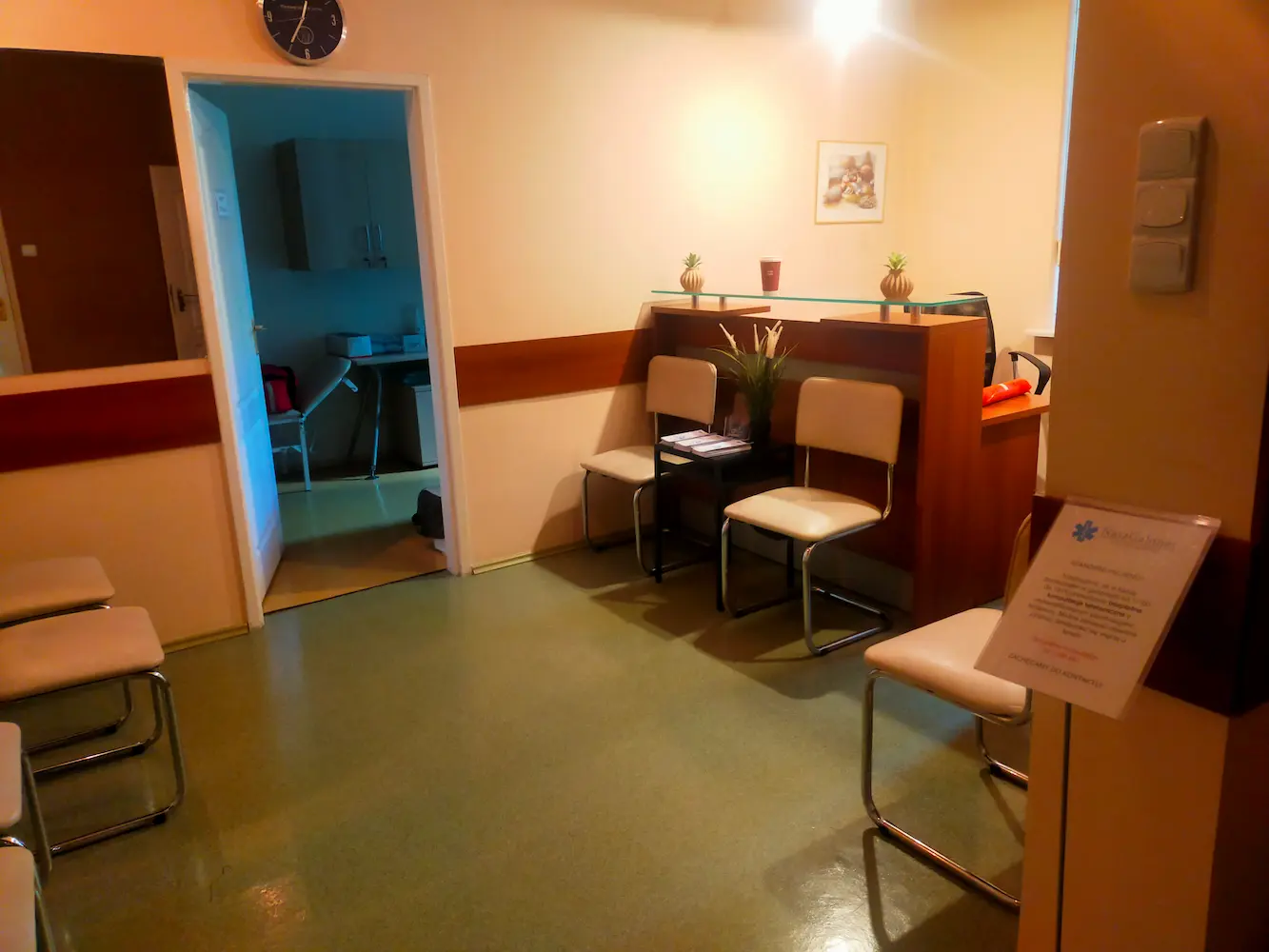
Address: Augusta Cieszkowskiego 5, 85-065 Bydgoszcz
Opening hours: Monday to Sunday, 8:00-20:00
Booking: by phone on 880 808 880 or through the online booking system on this site
The procedures are performed by doctors who work with people with addictions. Nasz Gabinet has been operating for over 10 years and runs clinics in 21 cities; the Bydgoszcz clinic sees patients from the city and the surrounding area, most often from Toruń, Inowrocław, Świecie, Nakło and Koronowo.
The procedure takes place on an outpatient basis, with sterile single-use equipment. The records contain no markings pointing to addiction treatment, and we set the appointment individually, at weekends as well.
This page is for information only and does not replace a medical consultation. Whether an implant is the right solution in a particular situation is decided by a doctor after an examination.