What is the anti-alcohol injection and how does naltrexone work?
The anti-alcohol injection is the everyday name for treatment with extended-release naltrexone. A single injection contains 380 mg of naltrexone sealed inside microspheres, from which the drug is released slowly over the following weeks. The product is sold under the trade name Vivitrol, and a nurse or doctor gives it deep into the gluteal muscle once every 4 weeks.
How naltrexone takes the pleasure out of alcohol
Naltrexone is an opioid receptor antagonist, so it blocks these receptors rather than stimulating them. When someone drinks, this has a concrete effect: alcohol triggers a release of endorphins in the brain, and these bring the pleasure and relaxation that many people are reaching for. When the receptors are occupied by the drug, that reward signal does not get through. Drinking becomes less satisfying, and after a few such disappointments the alcohol craving itself quietens. Naltrexone is not intoxicating and not addictive; apart from the response to alcohol, it changes neither mood nor the way you think.
How many weeks one naltrexone injection lasts
After the injection the blood concentration of naltrexone rises quickly: the first peak comes after roughly 2 hours, the second after 2-3 days, and from around day 14 the drug begins to recede. Traces can remain detectable for longer than a month, yet the manufacturer notes that its effect weakens in the second half of the cycle. Hence the rhythm of a dose every 4 weeks: the next one arrives before the protection has time to fall away, and with it the alcohol craving would return.
Medical assessment before the injection in Warsaw
The first appointment in Warsaw does not end with an injection. At our practice at ul. Warowna 1/U4 in the Mokotów district we begin with assessment: the doctor checks whether naltrexone is safe for a given person and whether it makes sense in their situation at all.
What the interview before the injection covers
The conversation covers the history of drinking and earlier attempts to stop, the date of the last drink and every medicine being taken, with particular attention to painkillers and opioids. The doctor asks about chronic illnesses, assesses mood and the risk of relapse, examines the site where the injection is to go and looks for signs of liver disease. The aim is to catch the situations in which the drug must not be given.
If someone is still drinking or is in the middle of withdrawal, we deal with preparation first, which sometimes includes alcohol detox in Warsaw. The injection is not given while an active withdrawal syndrome is present.
Giving the injection and check-ups every 4 weeks in Warsaw
On the day of administration the injection is given by a nurse or a doctor, never by the patient alone. Before that happens, the team confirms that nothing has changed since assessment: that no opioids have appeared, there are no withdrawal symptoms, there is no pregnancy and no procedure requiring strong painkillers is coming up.
What the day of the injection looks like
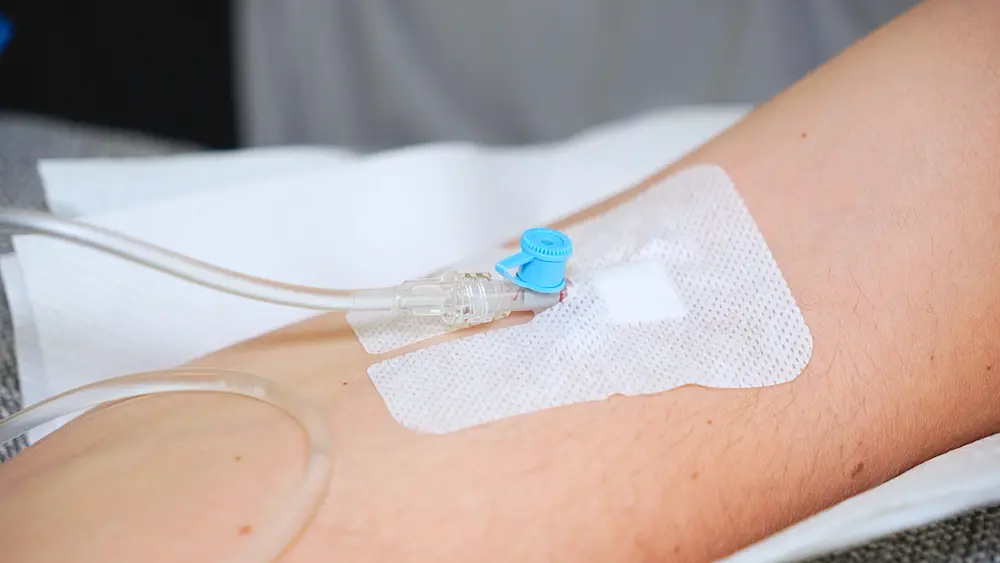
We keep the product in the fridge at 2-8°C and take it out about 45 minutes before the injection so that it reaches room temperature. The suspension is prepared just before administration and injected deep into the gluteal muscle, each time into a different buttock, never into a vein or under the skin. The injection itself takes a moment, after which the patient stays a while longer for a short observation.
Follow-up visits for the successive injections
The next injections come round roughly once a month. At each visit the doctor looks at two things: whether the treatment is working, that is how abstinence, craving and engagement in therapy look, and whether it is safe, that is the site of the last injection, the liver, mood and any new medicines. A late dose is made up as soon as possible, but no sooner than 4 weeks after the previous one and in no dose greater than 380 mg.
How long treatment with naltrexone lasts
There is no rigid end date. The manufacturer's drug information does not state how long therapy should last. The reference points are external and inconclusive: SAMHSA speaks of at least six months to a year, noting that the optimum remains unknown, while the American VA/DoD guidelines advise stopping treatment when it brings no benefit for 3 months. In practice the length is decided by the doctor together with the patient on the basis of results. After the last injection the protection fades, so we plan the point of ending in advance, all the more since sensitivity to opioids changes at that time.
Is the anti-alcohol injection safe? Contraindications
Naltrexone has long been used in addiction treatment and, with sound assessment, is regarded as a well-understood drug. Side effects do occur, most often harmless ones: nausea, headache, fatigue, muscle and joint pain, and sometimes a reaction at the injection site. One warning, however, carries a completely different weight from the rest.
Reduced opioid tolerance and the risk of death
During treatment and for some time after it, the body loses its earlier tolerance to opioids. Trying to break through the block with a larger dose, or going back to pre-treatment doses, can end in respiratory arrest and death. The risk is greatest towards the end of the 4-week cycle, after a missed dose and after stopping the drug, which is why for at least 30 days from the last injection no opioid medicines of any kind may be taken. The patient receives an information card about naltrexone treatment and carries it, because in the event of injury or surgery the medical team must know about it.
Contraindications: when to wait or to give up the injection
Some of the obstacles stem from what the patient is taking or has recently used:
- opioids in any form, including those hidden in painkillers, cough and anti-diarrhoeal medicines, as well as in substitution treatment;
- an active withdrawal syndrome, that is alcohol withdrawal in progress;
- an imminent procedure in which pain is managed with opioids.
The second group of contraindications comes from the state of health, not from what is being taken. We will not give the injection in pregnancy, in acute inflammation or severe liver failure, or with an allergy to naltrexone or to the components of the suspension. Many such situations are reversible: once withdrawal has run its course and an acute liver condition has passed, it is usually possible to return to treatment. It is also worth knowing the warning signs. Jaundice, dark urine and abdominal pain mean that something is happening to the liver that calls for an urgent appointment; a worsening reaction after the injection and a clearly lower mood should be reported too.
Anti-alcohol injection or implant? Choosing in Warsaw
In Warsaw, someone who types "anti-alcohol injection" will mostly land on offers for the implant. These are two different methods, and there is a third as well: tablets. Before a decision is made, it is worth seeing how they differ, because they rest on opposite principles.
- The naltrexone injection quietens the craving. Nothing bad happens after a drink, but alcohol stops being enjoyable, and the drug is given into a muscle every 4 weeks.
- The disulfiram implant works by deterrence: after alcohol it produces strong, unpleasant symptoms. It is placed under the skin during a short procedure, which we describe on the page about the Esperal alcohol implant in Warsaw.
- Naltrexone in tablet form is the same substance as in the injection, only taken daily.
None of these methods can be called the best in advance. The implant deters, the injection quietens the craving, the tablets demand daily discipline. Which option to choose is settled by the doctor and the patient at assessment, taking into account the history of drinking, co-existing illnesses and what the patient expects from treatment.
Whom the injection form can suit better
A monthly injection frees the patient from having to remember a daily tablet and, unlike the implant, does not rely on fear of a violent reaction. This does not mean it suits everyone, because that is what assessment decides. The point is to match the tool to the situation, not the other way round.
Availability of help, cost and booking a visit in Warsaw
Alcohol is exceptionally easy to come by in Warsaw. The city has counted over 6,000 places where it can be bought, including about 3,000 shops, and although the city council has been gradually lowering the cap on alcohol sales permits since 2022, the scale remains enormous. It is visible from the other side too: the Warsaw Centre for Intoxicated Persons admits about 19,000 people a year, and that is more than half fewer than a decade ago.
Access to alcoholism treatment in Warsaw
Since alcohol is so close at hand, it is worth asking how close help is. Warsaw has plenty of addiction treatment clinics under the National Health Fund (NFZ), but they can have waiting lists, and some people look for a solution they can start without a referral and without waiting. The anti-alcohol injection is one such option. It does not replace addiction therapy in Warsaw; it supports it, easing the craving between sessions, and it remains part of broader alcoholism treatment in Warsaw.
How much the anti-alcohol injection costs in Warsaw
The price cannot be summed up in a single figure, because treatment has several components, and some depend on the individual person:
- the assessment consultation together with laboratory tests;
- the drug itself;
- each administration and the care that follows, returning every 4 weeks.
Because the treatment is cyclical, it is best seen as an expense spread over the months. We present a specific quote after assessment, once it is clear what range of tests and what rhythm of injections will be needed.
How to book an assessment in Warsaw
Booking is simple: you book a slot online in the booking tool alongside, or call 880 808 880. This is a private appointment, so you do not need a referral, and it takes place at our practice at ul. Warowna 1/U4 in the Mokotów district. The doctor then takes a history and, if nothing stands in the way, qualifies you for the injection. It is worth remembering that the injection is part of treatment, not the whole of it, because new habits are learned in therapy, which is why we run it together with addiction therapy in Warsaw.