What body fat does to hormones and why obesity is treated as a chronic disease
Obesity appears in ICD-10 under code E66, and the Polish Society for the Treatment of Obesity (PTLO), in its 2024 guidelines, describes it as a chronic disease that does not resolve on its own and returns after a break in treatment. Adipose tissue releases leptin, the satiety hormone, which the hypothalamus stops responding to over time, so the brain sends out a hunger signal even though the body has fat in reserve. After every diet the body slows its metabolic rate and raises the level of ghrelin, the hunger hormone, which is why someone who has lost weight on a diet usually eats more a few months later than before the diet and puts the weight back on.
Fat also changes the level of the sex hormones. Inside adipose tissue male hormones are converted into oestrogens, and an excess of insulin lowers the blood level of sex hormone binding globulin, so women end up with more free testosterone while in men the testosterone level falls. In a woman the cycle becomes irregular, ovulation stops and it is harder to conceive; in a man the sex drive falls, erectile problems appear and the quality of the semen deteriorates. According to the PTLO, between 32.7 and 45 percent of men with obesity have a low testosterone level, and in most cases this is a consequence of the obesity rather than its cause. These disturbances usually reverse once the patient loses weight, which is why at Nasz Gabinet Gdynia we start couples who are trying for a baby on obesity treatment before they go to an IVF clinic.
We run the treatment the way high blood pressure is treated: we make the diagnosis, choose a drug, review the patient every month, change the drug when it stops working, and plan in terms of years. The doctor assesses whether the patient is eligible for drug treatment and keeps track of the tests, the dietitian plans the meals, and the specialist in the psychology of eating works with the patient on not eating under the influence of emotion. For a woman planning a pregnancy and for a man trying for a baby the treatment follows a separate timetable, which we set out in the section on fertility.
How we recognise obesity and why we ask about pregnancies, the cycle and sex drive
The first measurement is BMI, body weight in kilograms divided by height in metres squared; a woman 165 cm tall weighing 84 kg has a BMI of 31. Under the thresholds set by the World Health Organization and adopted by the PTLO, overweight begins at 25, class I obesity at 30, class II at 35 and class III at 40. The second measurement is waist circumference, taken midway between the lowest rib and the top of the hip bone. From 80 cm in women and 94 cm in men the International Diabetes Federation counts this as abdominal obesity, even when BMI is normal. Visceral fat, which sits around the liver and the intestines, releases inflammatory substances and leads to insulin resistance, diabetes and heart disease faster than fat on the hips.
The third element is the history of the patient's weight, which we go through in detail. We ask a woman how much she weighed before her first pregnancy, how much she gained in each pregnancy and how much of that stayed after the birth, whether her periods are regular and whether a gynaecologist has ever mentioned polycystic ovary syndrome. We ask a man when he started to put on weight, whether his sex drive has fallen and whether he and his partner are trying for a baby, because that changes the choice of drug. We ask both of them about previous attempts to lose weight and how quickly the weight returned, about sleep, snoring, alcohol and medicines, and about whether they have episodes of binge eating.
The BMI at which we start drug treatment at our practice on ul. Sokoła and when a woman with polycystic ovary syndrome is eligible
From a BMI of 30 the index alone is enough for drug treatment. From a BMI of 27 a drug may be prescribed once obesity has already caused a complication: prediabetes or type 2 diabetes, high blood pressure, lipid disorders or sleep apnoea. Polycystic ovary syndrome is not on that list, but insulin resistance, abnormal fasting glucose and high triglycerides are common in women with the syndrome, so a woman with a BMI of 28 and even one of those findings in her test results meets the criterion. Between a BMI of 25 and 27 we treat with diet and exercise, and we consider a drug only in abdominal obesity with insulin resistance in the test results. Obesity is treated here by doctors specialising in internal medicine who hold the PTLO certificate, because obesity specialist is a certificate rather than a separate specialty; infertility is treated by a gynaecologist and an andrologist, with whom we exchange records.
What the first year of obesity treatment in Gdynia looks like, from the first appointment to a stable weight
The first appointment, at the practice or online, costs PLN 250. The doctor goes through the history of the patient's weight and their list of medicines, weighs the patient, measures waist circumference and blood pressure, looks at the test results and orders the missing ones. A woman of childbearing age is asked about the date of her last period and about contraception, because without effective contraception the PTLO does not recommend any of the obesity drugs. A patient who has a full set of results and meets the criteria leaves with an e-prescription for the starting dose, instructions for the injection and an appointment with the dietitian; a patient planning a pregnancy in the coming months leaves with a plan that does not include a drug, described in the section on fertility.
For the first 3 months we raise the dose every 4 weeks and hold a follow-up by video call: the patient gives their weight, their blood pressure readings and how they are tolerating the drug, and the doctor decides on the next dose and sends the e-prescription code. Between the fourth and the sixth month we check in the blood tests what has changed in blood glucose, lipids and liver enzymes, and whether body weight has fallen by at least 5 percent, because the PTLO treats that threshold as evidence that the drug is working; a patient who has not reached it is given a different product. From the seventh to the twelfth month the dose stays the same, follow-ups take place every 4 to 8 weeks, and the dietitian makes sure the patient is not losing muscle. After a year we decide whether the drug stays or we start to withdraw it.
What we do not do at Nasz Gabinet Gdynia when treating obesity
- We do not prescribe obesity drugs to a woman who is pregnant, who is breastfeeding or who wants to become pregnant in the coming months. Semaglutide has to be stopped at least 2 months before a planned conception and tirzepatide at least a month; during pregnancy itself we give none of the five drugs.
- We do not treat infertility and we do not give testosterone. Ovulation is stimulated by the gynaecologist, semen is assessed by the andrologist, and testosterone given from outside suppresses sperm production, so it harms a man who is trying for a baby. We treat the obesity that lowers fertility, and we pass the results to the doctor looking after the couple.
- We do not see anyone under 18. Children and adolescents with obesity are looked after by paediatric clinics and by paediatric endocrinology clinics.
Which tests we do in Gdynia before the first prescription and when we measure testosterone
Before we issue the first prescription we want to see eight results: fasting glucose, glycated haemoglobin, a lipid profile, the liver enzymes ALT and AST, creatinine with eGFR, TSH, uric acid and a full blood count. Glycated haemoglobin shows the average blood glucose over 3 months and separates prediabetes from diabetes. eGFR shows how the kidneys filter the blood, and that figure decides which drug may be given; TSH rules out an underactive thyroid; ALT and AST show whether fat is damaging the liver. Results from the past six months, from a GP surgery or from an occupational health check, we accept without repeating them. Any missing tests the patient has done at any laboratory in Gdynia or in their own town, and sends us a photograph of the results before the appointment.
We look at the list of medicines as carefully as at the results: we ask for the packs or for photographs of them, including over-the-counter medicines, supplements and contraception. Steroids, insulin, the older diabetes tablets from the sulfonylurea group and some antiepileptic and antidepressant drugs cause weight gain in themselves, and bupropion, a component of one of the obesity drugs, interacts with many of them.
When we test testosterone in a man and refer a woman to a gynaecologist before starting a drug
The PTLO does not recommend hormone tests in every patient with obesity, because mild hormonal disturbances are usually a consequence of the obesity and reverse once the patient loses weight. The exception is Cushing's syndrome, which we suspect when a young person has purple stretch marks, a rounded face and high blood pressure; according to the PTLO it affects about 0.9 percent of patients with obesity. In a man we measure total testosterone in the morning when he reports a lower sex drive, erectile problems or muscle weakness, or when he and his partner are trying for a baby, and also when he has type 2 diabetes or several components of the metabolic syndrome. If the result is low or at the lower limit we order further tests: sex hormone binding globulin, LH, FSH and prolactin, and in infertility a semen analysis with an andrologist. A woman with irregular periods, excess hair growth or acne we refer to a gynaecologist, because polycystic ovary syndrome is diagnosed against the Rotterdam criteria, when two of the three features are present: infrequent ovulation, an excess of androgens visible on the skin or in a blood test, and the appearance of the ovaries on ultrasound; the ultrasound is done by the gynaecologist. We do not wait for the syndrome to be confirmed: we treat the obesity straight away, alongside the investigations at the gynaecologist.
How we treat obesity in a woman who wants to become pregnant and in a man with low testosterone
Obesity lowers fertility in both partners. A couple can start obesity treatment straight away, with no referral and at any age, unlike most stages of infertility treatment. The PTLO recommends that a woman with obesity loses weight before she decides on a pregnancy, and all the more so before assisted reproduction. The same rule applies to men, although the evidence there is weaker.
How losing weight restores ovulation in polycystic ovary syndrome
Polycystic ovary syndrome is the commonest cause of absent ovulation, and obesity makes it worse: an excess of insulin raises the level of free testosterone, follicles in the ovary stop maturing, and cycles grow longer or disappear. The PTLO reports that losing 5 to 15 percent of body weight regulates the cycle in these women, restores ovulation and brings androgens down; in women with infertility who do not have the syndrome, the same effect calls for a 10 percent weight loss. In an Australian trial from 1998, 67 women with obesity and absent ovulation went through a six-month programme of diet and exercise: ovulation returned in 60 of them, 52 became pregnant and 45 gave birth, and the miscarriage rate in the same women fell from 75 percent before the programme to 18 percent after it. In trials cited by the PTLO, women with the syndrome for whom diet had not worked were given semaglutide at a dose of 0.5 mg once a week: after 3 months they had lost an average of 7.6 kg and after six months 11.5 kg, BMI fell from 34.4 to 29.4, and in 80 percent of the women in whom the drug worked the cycle returned to normal. Women in this group taking liraglutide lost 5.2 kg over six months. An obesity drug is not a fertility drug and does not replace treatment with a gynaecologist; it restores ovulation through weight loss, and then it has to be stopped before the couple start trying.
What obesity changes about the chances of IVF and when we do not ask a patient to lose weight first
In a meta-analysis of 21 studies published in 2019, women with a BMI of 30 or more had a 15 percent lower chance of a live birth after in vitro fertilisation than women of normal body weight, and those with both obesity and polycystic ovary syndrome did worst of all. Obesity worsens the quality of the eggs and makes it harder for the embryo to implant in the lining of the womb. The government infertility programme sets no BMI threshold, but it funds up to 4 cycles with the woman's own eggs and only up to the age of 42, so it would be a waste to lose even one cycle. To a woman in her thirties with a BMI of 34 we suggest six months of obesity treatment before the first cycle, and we agree that plan with her clinic. A woman in her forties, whose ovarian reserve falls with every year, we do not ask to postpone the procedure; we treat the obesity alongside the investigations at the clinic and stop the drug on a date agreed with the doctor running the cycle, at least 2 months before the transfer in the case of semaglutide. The decision on the order is left to the couple and their gynaecologist; we show them the trial results that say what six months of obesity treatment achieves.
In a man with obesity we treat low testosterone with weight loss, not with testosterone injections
A man with obesity more often has a low sperm count: in a meta-analysis of 21 studies covering 13,077 men, the risk of a low sperm count or of no sperm at all in the semen was 28 percent higher with obesity than in men of normal body weight, and twice as high at a BMI of 40 or more. Testosterone rises after weight loss: in a meta-analysis of 24 studies a low-calorie diet raised total testosterone by an average of 2.9 nmol/l and bariatric surgery by 8.7 nmol/l, the more so the more weight had been lost. According to the PTLO, testosterone rises after a weight loss of as little as 5 to 10 percent. Less is known about whether better hormones translate into better semen: a review of 32 studies from 2026 judged the evidence to be weak, and in randomised trials the semen parameters after weight loss did not differ from those in the control group. So in a man who is trying for a baby we treat the obesity for the sake of his hormones, his blood glucose and his blood pressure, and we leave the semen to the andrologist to assess. We do not give testosterone injections: they suppress sperm production and reduce a man's chance of conceiving instead of increasing it.
When we stop each drug before pregnancy and whether they weaken the contraceptive pill
In the clinical trials of obesity drugs, as the PTLO notes, participants became pregnant fairly often even though they were supposed to be using contraception. For that reason every woman of childbearing age gets a drug from us only once her contraception is settled, and before a pregnancy she stops it within the period given in the summary of product characteristics.
| Drug | Contraception during treatment | Stopping before a planned pregnancy | Pregnancy and breastfeeding |
|---|---|---|---|
| Semaglutide | Required; it does not weaken the contraceptive pill | At least 2 months before conception, because the drug stays in the blood for a long time | Contraindicated in pregnancy and while breastfeeding |
| Tirzepatide | Required; for 4 weeks after starting and after every dose increase we ask for a second method alongside the pill | At least a month before conception | Not recommended in pregnancy; while breastfeeding the decision is taken with the gynaecologist, because only traces pass into the milk |
| Liraglutide | Required | Stop when the woman starts trying to conceive | Contraindicated in pregnancy and while breastfeeding |
| Naltrexone with bupropion | Required | We do not give it to a woman who is planning a pregnancy | Contraindicated in pregnancy and while breastfeeding |
| Orlistat | Required; with severe diarrhoea the contraceptive pill may fail | Stop when the woman starts trying to conceive | Contraindicated in pregnancy and while breastfeeding |
The European summary of product characteristics for semaglutide calls for no extra protection. For tirzepatide the European summary states that the level of hormones from the pill falls after the first dose, and treats that fall as of no clinical significance, while the American label for the same drug advises an additional barrier method for 4 weeks after starting and after every dose increase, or a switch from the pill to a coil or an implant. We ask our patients to take the more cautious option, because slower gastric emptying changes absorption most in the week after a dose increase. The PTLO also points out that the intrauterine coil and the implant are the most reliable methods in women with obesity, and that the levonorgestrel emergency contraceptive pill works less well above a body weight of 70 kg.
What we do if a patient becomes pregnant during treatment and what pregnancy is like in a woman with obesity
A patient who sees a positive test stops the drug the same day and rings us, and we write to her gynaecologist to say which drug she was taking, at what dose and until when. An American analysis from 2026 compared 429 women who were still taking semaglutide in early pregnancy with women who had stopped it earlier and with women who had never taken it: both treated groups had excessive weight gain in pregnancy, gestational diabetes and caesarean section more often than the untreated women, but they did not differ from each other. The authors put this down to appetite returning after the drug is stopped rather than to any effect of the drug on the foetus. So we plan the withdrawal of the drug before a pregnancy with the dietitian just as carefully as we plan starting it, so that appetite does not come back in the first weeks of pregnancy. During pregnancy itself we do not treat obesity with drugs. Under the guidelines cited by the PTLO, a woman with a BMI of 30 or more should gain 5 to 9 kg over the whole pregnancy, at her first appointment with the gynaecologist she has a glucose tolerance test, and she starts taking folic acid at a dose of 800 micrograms a day before conception. After the birth, for as long as she is breastfeeding, she stays under the care of the dietitian and is not given a drug; she returns to drug treatment once the baby is weaned.
How the once-weekly injection works and how much weight was lost in the STEP and SURMOUNT trials
GLP-1 is a hormone the gut releases after a meal and which sends the brain the signal that enough has been eaten. A GLP-1 analogue, also called a GLP-1 receptor agonist, is a longer-lasting copy of it: it works for several days rather than several minutes, slows gastric emptying and strengthens the satiety signal in the hypothalamus. Patients describe it like this: after half a plate they do not want the rest, and the thought of food stops coming back every hour. Tirzepatide also stimulates the receptor for a second gut hormone, GIP, and brings body weight down further. Semaglutide and tirzepatide are injected under the skin of the abdomen or the thigh once a week, liraglutide every day; the dose is raised every 4 weeks so that the stomach has time to get used to it. Five substances are authorised for obesity in Poland: these three analogues, the combination of naltrexone with bupropion, and orlistat.
How much a patient weighing 84 kg can lose in a year and when we decide that a drug is not working
In the STEP 1 trial people on semaglutide 2.4 mg lost an average of 14.9 percent of their body weight after 68 weeks, against 2.4 percent on placebo. In the SURMOUNT-1 trial people on tirzepatide 15 mg lost 20.9 percent after 72 weeks, against 3.1 percent on placebo. Liraglutide 3 mg in the SCALE trial brought body weight down by 8.4 kg after 56 weeks, against 2.8 kg on placebo. A woman weighing 84 kg can therefore expect about 12 kg less on semaglutide and about 17 kg on tirzepatide, but the spread in every trial was wide: some people lost twice as much, others almost nothing. After 3 months at the target dose we check whether 5 percent has gone; if not, we change the product, usually from semaglutide to tirzepatide. In a woman with polycystic ovary syndrome we also record the length of her cycles, because their return to normal is separate evidence that the drug is working. After about a year the fall stops, because the body now uses only as much energy as it gets in the smaller portions; from that point the drug no longer takes weight off, it holds the new weight steady.
How we withdraw the drug so that the weight does not return, including before a planned pregnancy
The STEP 1 participants whose drug was stopped at the end of the trial and whose care came to an end put back on two thirds of the weight they had lost within a year, and their blood glucose and blood pressure returned to pre-treatment values. We therefore treat withdrawal as a stage with a plan of its own: we lower the dose gradually while the weight is stable, the patient has a meal plan ready and a fixed exercise plan, and follow-ups continue for several months after the last injection. Before a pregnancy there is no such tapering, because the drug has to clear the body by a set date; through the weeks in which appetite returns the dietitian looks after the patient and makes sure that at the moment of conception she weighs what she weighed on the day of the last dose. A patient who comes back to treatment after the birth and after breastfeeding ends starts again from the starting dose.
Five obesity drugs under their brand names, their indications and the cost of a month
Wegovy, Mounjaro, Saxenda, Mysimba and Xenical hold a marketing authorisation for the treatment of obesity. Ozempic, Rybelsus and Victoza contain the same substances as Wegovy and Saxenda, but their only indication is type 2 diabetes. What a drug may be prescribed for is decided by the indication written into the summary of product characteristics, not by the active substance.
Why a woman without diabetes gets Wegovy from us rather than Ozempic
Ozempic, that is semaglutide at doses up to 2 mg, and Rybelsus, the same drug in tablet form, are authorised in type 2 diabetes, while Wegovy, semaglutide at doses up to 2.4 mg, is authorised in obesity, on the strength of the STEP programme trials. Saxenda is liraglutide 3 mg for obesity, Victoza the same drug at up to 1.8 mg for diabetes, and Mounjaro, that is tirzepatide, holds an authorisation in both diseases. Someone without diabetes taking Ozempic is using the drug outside its indication and at a dose that has not been studied in obesity; if the prescription was issued with reimbursement, the National Health Fund (NFZ) can recover the money from the doctor. Ozempic has at times been on Poland's list of medicines at risk of shortage, so every pack dispensed to someone without diabetes is one pack fewer for a patient with diabetes who cannot keep their blood glucose in check without it. To a patient without diabetes we prescribe a product authorised in obesity, and for a woman planning a pregnancy we also choose the drug by how long it takes to clear the body.
From PLN 160 to PLN 1900, the pharmacy prices of the five drugs in September 2026
The patient pays for the drug themselves, because the NFZ reimburses none of the five products in the treatment of obesity. The prices are approximate: Xenical PLN 160 to 350 a month, Mysimba PLN 370 to 600, Wegovy PLN 550 to 890, Saxenda PLN 500 to 1250, Mounjaro PLN 800 to 1900. The lower figure in each range is the price of the starting dose in the first weeks, the higher one the price of the target dose after a few months; the range for Saxenda is so wide because cheaper liraglutide generics are now sold alongside the original. The same packs differ between pharmacies by several dozen zloty, so before taking the e-prescription to the counter the patient compares prices at pharmacies in Gdynia and in an online price comparison tool. A woman preparing for IVF pays the same for a month of treatment as any other patient; no programme contributes to that cost.
When a patient gets Mysimba or Xenical from us rather than an injection
Mysimba, that is naltrexone with bupropion, acts on the satiety centre and the reward system in the brain. In the COR-I trial participants lost 6.1 percent after 56 weeks, against 1.3 percent on placebo. The summary of product characteristics requires the drug to be stopped if body weight has not fallen by 5 percent after 16 weeks. We do not give Mysimba in uncontrolled high blood pressure, epilepsy, bipolar disorder, a history of bulimia or anorexia, in patients treated with opioids or during alcohol withdrawal; nor does a woman planning a pregnancy receive it. Xenical, that is orlistat, blocks the absorption of about one third of the fat in a meal; over a year a patient loses 2 to 3 kg more on it than on placebo, but after a fatty meal they have oily stools that are hard to hold back. We choose tablets when a GLP-1 analogue is contraindicated, when the patient tolerates it badly or does not want injections. To a woman who wants to start trying for a baby in six months we more often suggest orlistat, because it is enough to stop it on the day she stops using contraception, with none of the 2 months of waiting needed with semaglutide.
Which symptoms after an injection settle on their own and which need to be seen the same day
More than one patient in ten has nausea, vomiting, diarrhoea or constipation in the first weeks, most often in the week after a dose increase; the symptoms ease as the stomach gets used to the drug. In the STEP 1 trial they led 4.5 percent of participants to stop treatment. Smaller portions help, as does dropping fatty food on the day of the injection, a glass of water between meals and vegetables with every meal. A patient who tolerates a new dose badly stays longer on the previous one. A patient who vomits for more than a day despite drinking rings us the same day, because they risk becoming dehydrated. A woman on the drug who has morning nausea and a late period takes a pregnancy test before she puts the nausea down to the drug.
Contraindications to the injection and the drugs whose doses we change from day one
A woman who is pregnant or breastfeeding does not receive a GLP-1 analogue; the dates for stopping before a pregnancy are given in the table in the section on fertility. We do not start treatment after an episode of pancreatitis, where there is medullary thyroid cancer in the family, or in heart failure with breathlessness at rest. We do not give liraglutide when eGFR is below 30 ml/min or after the age of 75; for semaglutide and tirzepatide there is little data in these situations and we decide case by case. In a patient on insulin or on a sulfonylurea we reduce those doses from the first injection to avoid hypoglycaemia, and with oral drugs where every change of dose counts, such as levothyroxine or anticoagulants, we check in blood tests whether the dose is still right, because slower gastric emptying changes their absorption. Before a planned general anaesthetic, including for gynaecological procedures and egg collection, the patient tells the anaesthetist about the drug, because food left in the stomach raises the risk of aspiration; the anaesthetist decides how long the break should be.
Abdominal pain, jaundice and sudden loss of vision, the symptoms we do not wait on until the next follow-up
Severe pain in the upper abdomen radiating to the back, with vomiting, can mean pancreatitis. Pain under the right rib cage with a fever or yellowing of the skin can mean gallstones; in the semaglutide trials 1.6 percent of those treated developed them, more often the ones who lost weight fastest. A sudden loss of vision in one eye calls for an urgent appointment with an ophthalmologist: in 2025 the European Medicines Agency added ischaemic damage to the optic nerve to the summary of product characteristics for semaglutide as a very rare side effect. A patient on insulin who feels weak, sweats and has shaking hands eats something sweet and rings us so that we can lower the doses. The signs of dehydration, that is dizziness on standing, dark urine passed in small amounts and a dry mouth after a day of vomiting, call for an appointment the same day, because dehydration damages the kidneys.
Why the drug is bought only at a pharmacy and never from an advert
Before it dispenses, a pharmacy checks the batch number in the European verification system, and nobody checks a pen bought from an advert. In October 2023 Poland's Chief Pharmaceutical Inspectorate (GIF) withdrew a falsified batch of a semaglutide medicine from the country, and in Austria in the same month several people were admitted to hospital with severe hypoglycaemia, because a counterfeit pen contained insulin instead of semaglutide. Vials sold online as a research peptide are not a medicine and nobody is answerable for what is in them or for whether they are sterile. Our patients take their e-prescription to a pharmacy, and the dose is changed only by the doctor.
What to eat on the drug to lose fat rather than muscle, and what a specialist in the psychology of eating is for
The dietitian agrees with the patient a deficit of 500 to 750 kcal a day below their requirement, as the PTLO recommends. They also keep an eye on protein, 1 to 1.5 g per kilogram of ideal body weight, the weight the patient should be, spread over three meals, because on a drug that takes appetite away it is easy to eat one sandwich all day and lose muscle instead of fat. Added to this is resistance training twice a week, even with resistance bands at home, and fluids, which patients on the drug easily forget about, because with smaller meals they drink less as well. For a woman with polycystic ovary syndrome we do not draw up a separate diet: under the international guidelines from 2023 no diet works better than any other in this syndrome; what counts is a deficit the patient can keep to. When a patient is preparing for pregnancy the dietitian adds folic acid and checks iron and vitamin D, and after the birth, while she is breastfeeding, keeps her deficit no greater than 500 kcal so that her milk supply does not fall.
When a patient eats out of tension and what the specialist in the psychology of eating does about it
The drug dampens physical hunger, but it does not change the habit of reaching for food under tension: after an appointment at the fertility clinic, or after a night shift at the port. The specialist in the psychology of eating teaches the patient to recognise the moment when a hand reaches for food by itself, and to decide in advance what to do instead: go out for ten minutes, or eat the evening meal already planned. In couples being treated for infertility that moment is often the evening after a failed cycle. Eating out of stress differs from a binge in that the patient controls the amount and stops once they notice what they are doing. Someone who describes not being able to stop, eating fast and in secret and then feeling ashamed has an eating disorder; a meal plan will not treat it, so the specialist in the psychology of eating refers them to a psychotherapist. Appointments with the dietitian and the specialist in the psychology of eating are held at the practice or online, and the prices are in the price list.
How many calories alcohol has, how it lowers fertility and what an obesity drug has in common with a drug used in alcohol dependence
A gram of alcohol is 7 kcal, almost twice as much as a gram of sugar, and it does not fill you up at all. Two large beers in the evening, about 450 kcal, wipe out almost the whole deficit agreed with the dietitian, and a bottle of wine with dinner is about 600 kcal. The liver burns alcohol first and fat only afterwards, so for several hours after a drink weight loss stands still. A GLP-1 analogue slows gastric emptying, so alcohol is absorbed with a delay, the patient does not feel how much they have drunk, and the nausea after the injection gets worse. In someone on insulin, hypoglycaemia after alcohol is easily mistaken for being drunk. While we are raising the dose we ask for no alcohol at all, and after that for no more than one drink a day, that is 250 ml of beer or 100 ml of wine. To a couple trying for a baby we say that alcohol lowers fertility in both of them and that there is no safe dose in pregnancy, so anyone who stops an obesity drug before trying to conceive does not go back to drinking at that point.
Naltrexone, a component of one of the obesity drugs, is also used in the treatment of alcohol dependence, because it reduces the pleasure of drinking. There is less of it in the obesity drug, but the summary of product characteristics requires alcohol to be kept to a minimum, because together with bupropion it raises the risk of seizures. During alcohol withdrawal the drug is contraindicated. Semaglutide was tested in people with dependence in a phase two trial from 2025: 48 participants were given the drug or placebo for 9 weeks, and those on semaglutide felt less craving for alcohol and drank less on the days when they did drink; this is too small a group to treat dependence with it. To a patient who drinks every day or cannot stop we offer alcoholism treatment in Gdynia, at the same practice, and for other substances addiction therapy; we start obesity treatment once the withdrawal symptoms have settled and run it alongside the therapy.
When a patient comes to the practice in Gdynia and when they join the doctor from home
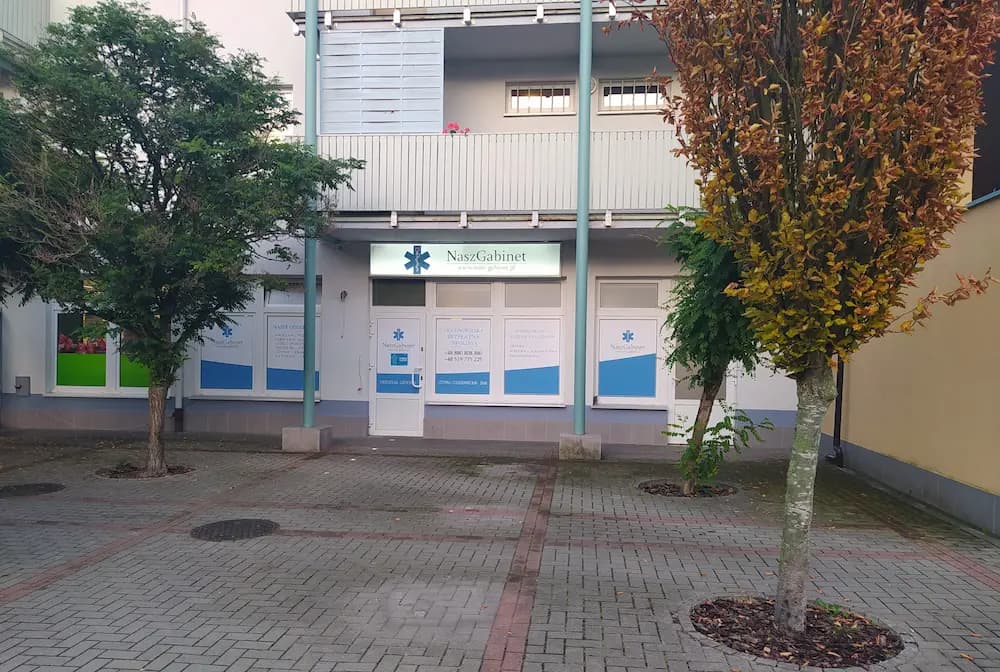
The first appointment takes place at our practice at ul. Sokoła 28 in Gdynia, because the doctor wants to weigh the patient on scales made for a high body weight, measure the waist and take blood pressure with a cuff of the right width. The doctor also examines the abdomen and looks at the skin of the neck and the armpits, where dark patches give away insulin resistance, and asks a woman about hair growth and acne, the signs of an excess of androgens. A patient who cannot travel books the first appointment online and sends the test results and their own measurements in advance, and the doctor judges whether they need to be examined in person before a prescription is issued. Follow-ups every 4 weeks take place by video call: the patient gives their weight, blood pressure and any symptoms, and a woman with cycle problems also the dates of her periods, and the doctor sets the dose and sends the e-prescription code by text message. Every 3 months, after the blood tests, the patient comes to the practice for measurements. A woman who finds out during treatment that she is pregnant is given an appointment at the practice within a few days, and we send the letter to her gynaecologist the same day.
What the NFZ funds in obesity treatment in Gdynia and what the patient pays for, including before IVF
On the NFZ a patient gets an appointment with a GP, basic blood tests, an appointment at a metabolic clinic with a referral and bariatric surgery if they meet the criteria. In September 2026 four metabolic clinics work under the NFZ in Pomerania: one in Gdynia, two in Gdańsk and one in Chojnice, all of them on a referral from a GP. The NFZ reimburses semaglutide only in type 2 diabetes, for patients who meet the conditions on the reimbursement list; someone without diabetes pays the full price no matter who issued the prescription. A free dietitian's appointment under coordinated care at a GP surgery is available only for the conditions on a list that includes diabetes, high blood pressure and an underactive thyroid, but not obesity. Since June 2024 the government infertility programme has funded only the procedures at the clinic and not the treatment that precedes them; a couple with obesity therefore pay for obesity treatment before the programme themselves, or have it at a metabolic clinic with a referral.
With us the first medical appointment costs PLN 250, at the practice and online. Follow-ups and appointments with the dietitian and the specialist in the psychology of eating are paid for according to the price list, and the drug is bought at the pharmacy. In return the patient needs no referral and does not wait several months for a date, speaks to the same doctor all year, and we write the letter to a gynaecologist, an andrologist or a fertility clinic at no extra charge.
Who we refer for bariatric surgery in the Tricity area and when a pregnancy is allowed afterwards
We refer a patient for surgery at a BMI of 40 or more, or from 35 with a complication such as type 2 diabetes, high blood pressure or sleep apnoea, once non-surgical treatment with diet, exercise and drugs has been documented. In 2022 the international metabolic surgery societies lowered the thresholds to 35 without complications and to 30 in diabetes, but Polish centres still assess patients from 40 without complications and from 35 with a complication. Before the operation the PTLO requires a psychological assessment, and centres postpone surgery in active addiction, untreated depression and uncontrolled binge eating. The list of bariatric centres kept by the Association of Polish Surgeons has six units in the Pomeranian province: three in Gdańsk and one each in Wejherowo, Kościerzyna and Słupsk. The KOS-BAR pilot programme, which until 30 June 2026 gave patients dietitian and psychologist care after surgery, was run in March 2024 by three Pomeranian hospitals. The pilot has ended and has not been brought in permanently as a service covered by public health insurance, so patients arrange their own care before and after the operation.
Up to the day of the operation the patient stays under our care: we document the non-surgical treatment, complete the tests and make sure the patient loses weight, because a smaller liver gives the surgeon easier access to the stomach. Before the operation we tell a woman of childbearing age what the Association of Polish Surgeons recommends: a pregnancy is allowed 24 months after surgery, once the weight has stabilised, and until then reliable contraception is essential, because fertility comes back quickly after weight loss and a pregnancy happens before the woman expects it. In a pregnancy after a bypass operation the gynaecologist checks vitamin B12, folate and iron more often, because a deficiency leads to anaemia. Every patient takes supplements for life after the operation and has vitamin levels checked every year, and if the weight goes up after two or three years they come back to us, because an obesity drug works after surgery too.
Obesity treatment in Gdynia for patients from Gdańsk, Sopot, Wejherowo, Kartuzy and the whole of Pomerania
We have one practice in the Tricity area, at ul. Sokoła 28, so patients travel to it from Gdańsk and Sopot as well as from Rumia, Reda, Wejherowo, Puck, Władysławowo, Kartuzy, Żukowo, Kościerzyna, Pruszcz Gdański, Tczew and Starogard Gdański. The first appointment takes place in Gdynia, and after that the treatment looks the same as it does for patients living in the city: blood tests are done in the patient's own town, every 4 weeks they join the doctor by video call, and they come to the practice every 3 months. A couple under the care of a fertility clinic in Gdańsk or Gdynia give us the details of the doctor treating them, so that the information about body weight, test results and the date the drug is to be stopped reaches the clinic before the cycle begins.
How many people in Gdynia are waiting for an NFZ metabolic clinic and what follows from that
The NFZ metabolic clinic in Gdynia reported to the national waiting-times service that in July 2026 there were 742 people on its list and the average wait was 229 days, more than seven months. Of the two clinics in Gdańsk only one reports figures: 698 people and 126 days; in Chojnice in August 165 people were waiting, on average 56 days. A referral from a GP is valid anywhere in Poland, so someone living in Gdynia can put their name down where the list is shorter, but they will then be travelling there for follow-ups every few weeks for a year.
Seven months is the time in which a patient on a drug usually loses their first 5 to 10 percent of body weight. Anyone who does not want to wait that long starts treatment privately and buys the drug at the pharmacy, at the same price either way.